Key Art vs Hero Asset: What to Validate Before Full Production
-

Written byDenys Zadoienyi
-

Updated on23.09.2026
-

Time to read11 min

- Key Art and Hero Asset Are Not the Same Deliverable
- Why This Belongs Before Greenlight, Not After
- What Key Art Actually Buys You Before Gameplay Exists
- What a Hero Asset Tests That a Style Guide Can’t
- Running Both Together: The Greenlight Case
- In-House or Outside Partner: What Changes at This Stage
- Production Examples: What Public Work Can Show
- Quick Diagnostic Questions: Are You Ready to Greenlight?
- Getting the Sequencing Right
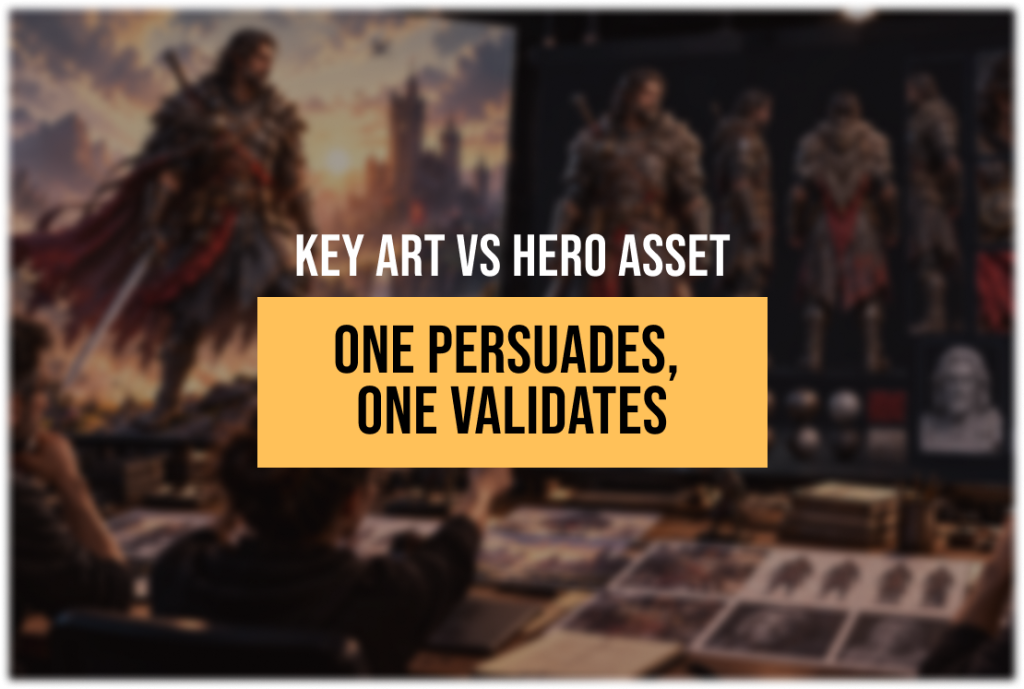
“Editorial illustration created for visual reference purposes. It does not represent a real project, client work, or official software screenshot unless stated otherwise.”
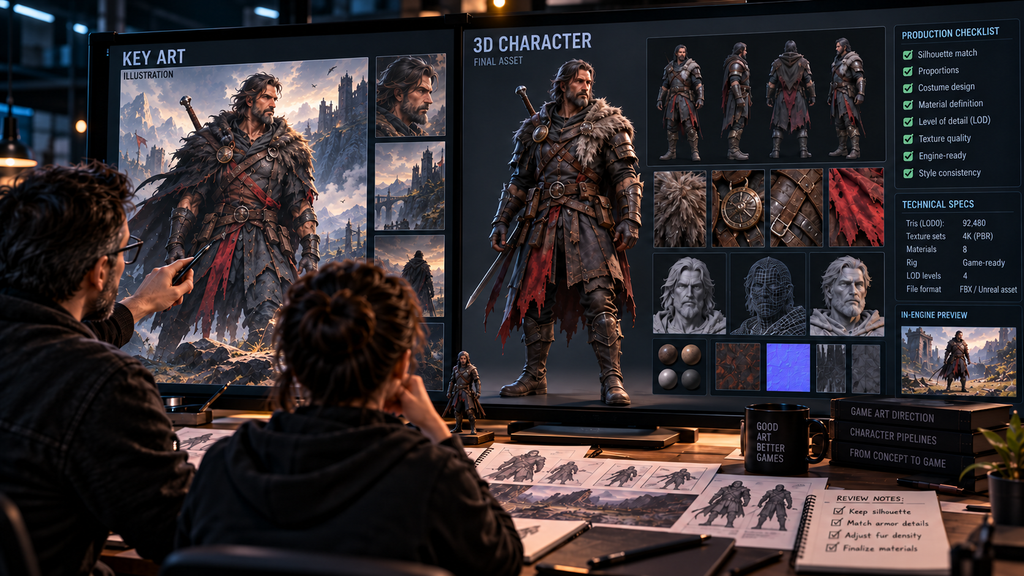
A publisher greenlight meeting, a platform-holder pitch, an internal budget review – all three ask the same question before a single system is fully playable: does this team actually know what the game looks like? A design document answers that question in words. A key art piece and a hero asset answer it in a form a stakeholder can react to in seconds, before the studio has committed the budget that full production requires. Treating either as a nice-to-have deliverable, rather than a pre-production decision tool, can leave visual-direction problems undiscovered until they’re substantially more expensive to change. This piece assumes some familiarity with what concept art actually does in a production pipeline and focuses specifically on two deliverable types within it that carry outsized weight at the pre-production stage.
A note on terminology before going further: “hero asset” gets used differently across studios – sometimes as a marketing centerpiece, sometimes as a gameplay-critical showcase object, sometimes as the production-validation piece this article focuses on. Here, hero asset means a production-quality reference asset built early enough to validate visual direction before that direction is scaled across a full cast or world. Confirm which meaning a brief intends before treating the term as self-explanatory.
Key Art and Hero Asset Are Not the Same Deliverable
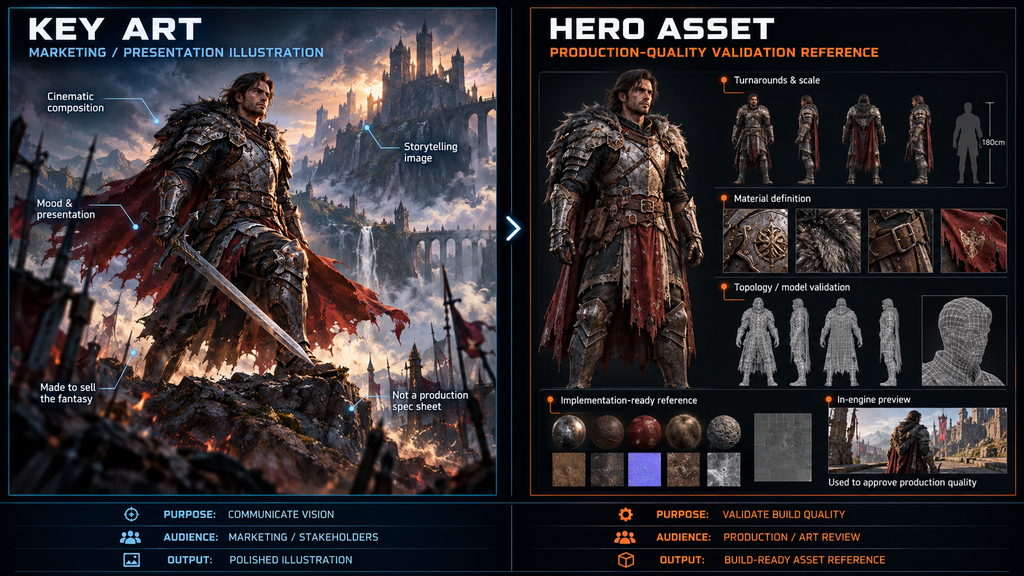
The two terms get used loosely enough in production conversations that it’s worth separating them before anything else. Key art is a high-level marketing or presentation image – built for a store page, a trailer, a press kit, or an announcement post, but just as often for a publisher pitch or an internal alignment meeting before any external marketing use exists. Its job is to sell or communicate the visual promise of the game to someone who hasn’t played it, often before there’s anything playable to show. It follows a marketing or presentation brief more than a production one: composition, lighting, and narrative framing carry as much weight as the subject matter itself.
In the production-validation sense used here, a hero asset is a different kind of deliverable entirely. It’s a fully realized, production-quality character, weapon, or environment piece built early and deliberately – not because that specific asset ships first, but because it’s the one thing the art director points to when anyone on the team asks what “on-style” actually means before the visual language has been proven at scale. Where key art faces outward, toward an audience, a hero asset faces inward, toward the production team.
“Editorial illustration created for visual reference purposes. It does not represent a real project, client work, or official software screenshot unless stated otherwise.”
The two are easy to conflate because they often get commissioned around the same milestone and can even share a subject – a hero character might headline both the key art and the first fully modeled 3D asset. But a piece that succeeds as key art (a dramatic three-quarter angle, dynamic lighting, an implied narrative moment) can be close to useless as a hero asset reference, because it doesn’t show the turnaround views, material breakdown, or in-engine readability a production team needs to build against it. Commissioning one when the brief actually calls for the other is a common source of wasted rounds at exactly the stage where a team can least afford them.
Why This Belongs Before Greenlight, Not After
For a producer, the cost of skipping this stage doesn’t show up as a missing deliverable – it can leave direction problems undiscovered until concepts are already approved and downstream production has started, at which point a correction touches more work than it would have earlier. Our own breakdown of concept art pricing by asset type documents how AAA hero-tier work carries wider cost bands specifically because of the deeper scrutiny and revision cycles it draws once marketing, leadership, and a broader group of stakeholders are all reviewing the same piece – the same dynamic that makes an unvalidated direction expensive to unwind once it’s been used to greenlight a schedule.
For an art director, the risk runs the other way: a visual direction that reads well in a mood board or a single polished painting can fail once it’s tested against the constraints a hero asset forces into the open – silhouette readability at actual render distance, material behavior under real-time lighting, how the design holds up next to a second and third character built from the same rules. A hero asset can then feed concrete lessons back into a written art bible – material rules, silhouette limits, complexity targets, and other constraints that are easier to define once they’ve been tested on a real asset than to guess at in advance.

What Key Art Actually Buys You Before Gameplay Exists
Key art’s value in pre-production has less to do with marketing and more to do with sequencing. A studio pitching a publisher, a platform holder, or an internal budget committee is being asked to justify spending against a vision that, at this stage, may not have a single finished level behind it. A design document communicates intent; key art demonstrates it. The difference matters in a room where the person approving the budget is not going to read forty pages of design rationale before deciding whether the project looks like something worth funding.
This is also why key art doesn’t follow the same production logic as a gameplay concept. A character or environment concept has to be functional – it has to translate cleanly into a 3D brief without leaving open questions. Key art’s job is closer to a movie poster: composition and mood have to carry weight the underlying gameplay hasn’t earned yet, because the audience it’s built for hasn’t played anything. ArtStation Magazine’s interview with a mobile marketing art director describes this as a distinct production track in its own right – illustrator, 3D marketing artist, and art director working in a tight feedback loop specifically to build one persuasive image, separate from the team building the game’s actual assets. Treating a key art commission as “a more finished concept sketch” tends to produce a piece that satisfies neither job well – underspecified as a production reference and underdeveloped as a piece of persuasion.
What a Hero Asset Tests That a Style Guide Can’t
A style guide written before any asset exists is, by necessity, a set of intentions. It states that the game should feel a certain way – grounded, exaggerated, weathered, clean – without yet proving that those intentions survive contact with an actual production pipeline. When a hero asset is being used as a production benchmark, it’s where those assumptions get tested against reality. It gives the studio a concrete place to test whether a described material logic actually renders as intended under the target engine’s lighting, whether a silhouette rule holds up once it’s built rather than sketched, and whether the visual complexity implied by concept art is something the studio’s actual pipeline and schedule can sustain across a full cast or world rather than one showcase piece.
Our breakdown of stylized character art direction covers what happens once that hero standard has to hold across an entire cast rather than a single piece – the milestone-by-milestone discipline of comparing every new character against the hero asset rather than against memory. This article is about the earlier decision: building that anchor deliberately, before the team scales past the point where a single course correction is still cheap.
Skipping straight from concept approval to full-cast production without a validated hero asset means the studio is scaling an unproven assumption. If the assumption holds, nothing was lost. If it doesn’t, the correction now touches every asset built against it rather than one.
Running Both Together: The Greenlight Case
“Editorial illustration created for visual reference purposes. It does not represent a real project, client work, or official software screenshot unless stated otherwise.”
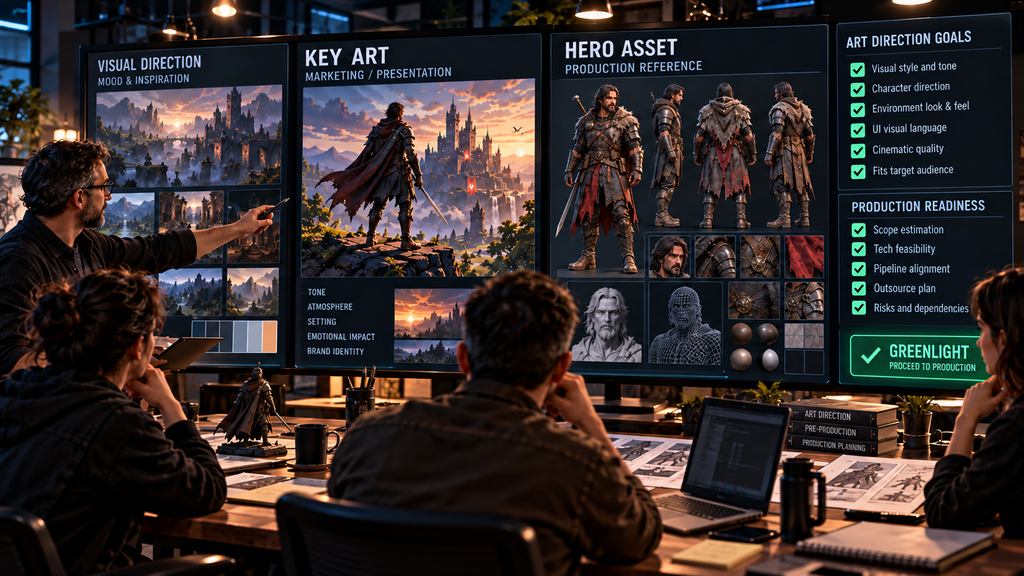
The reason these two deliverables are worth planning together, rather than commissioning whichever one a specific request happens to ask for, is that they answer two different audiences with the same underlying risk: an unproven visual direction. Key art helps communicate and sell the visual promise of the game to an external or internal decision-maker. A hero asset, when used as a production benchmark, tells the internal team the direction is worth scaling. A studio that has both walking into a greenlight conversation is showing two different kinds of validation – persuasive and technical – rather than asking a decision-maker to take the technical feasibility on faith because the persuasive piece looked strong.
There isn’t one universal order here. When technical feasibility is the main unknown – a new stylization approach, an ambitious material or lighting target – validating a representative production asset before locking marketing-facing key art tends to reduce rework, since the key art can then build on a direction the pipeline has already proven out. In pitch-led productions, though, key art may legitimately come first: a publisher pitch or an early funding conversation sometimes needs a persuasive image before a production team even exists to build a hero asset. The right sequence depends on which risk the team is actually trying to resolve first – persuasion or production feasibility – not a fixed rule for every project.
In-House or Outside Partner: What Changes at This Stage
Whether this work happens with an internal team or an outside studio matters less for the deliverables themselves than for how honestly the direction gets pressure-tested before it’s locked. An external review can add a fresh perspective when an internal team has been working inside the same visual assumptions for a long time, but it doesn’t replace internal art-direction ownership – it’s a different check, not a substitute for one. A partner brought in specifically to validate direction, rather than simply execute an already-locked brief, is being asked a different question: not “can you build this,” but “does this hold up before we commit to it.” That distinction is worth being explicit about in a brief, because a vendor scoped only for execution has little incentive to flag a direction problem they weren’t asked to look for.
Production Examples: What Public Work Can Show
The following reflects publicly documented work; specific budget or timeline figures are not disclosed for these engagements.
Wild Rage, for Whimsy Games. Nasty Rodent led the project’s overall art direction across concept art, characters, weapons, props, environments, and UI/UX. The public case doesn’t identify a specific hero asset or key-art deliverable, so it’s included here as evidence of cross-category art-direction work – holding one visual standard across every asset type on a single project – rather than as a disclosed hero-asset validation workflow.
Squad, for Offworld Industries. Our weapon and vehicle work on this project included concept art, unique visual treatments, and final production assets, built to match an established franchise’s visual identity. This is useful here as an example of concept work feeding directly into production assets under defined technical and visual constraints, not as a disclosed hero-asset case – Squad’s starting condition (an established franchise identity) also differs from a new IP’s pre-production stage, where the direction itself is still being set.
La Quimera, for Reburn. Our work on this project included props and weapons built to the project’s technical requirements and distinctive visual style. We don’t have a public source describing these pieces as pre-production validation anchors specifically, so this example is included simply as production-quality asset work under a defined art direction, not as a hero-asset case study.
Quick Diagnostic Questions: Are You Ready to Greenlight?
Worth answering honestly before a budget or publisher conversation:
- Can you show a single finished piece that represents the intended visual direction, or only reference boards and mood images?
- Has the visual direction been tested against the production constraints that matter for the target asset – scale, materials, lighting, camera distance, animation, or platform limits – or does it exist only as presentation art?
- If you built ten more assets tomorrow using the same rules, do you know what those rules are, or would each artist interpret the direction slightly differently?
- Does your key art (if you have one) represent a direction your 3D pipeline has actually validated, or is it aspirational?
- If a stakeholder asked “why does the game look like this,” could your art director answer in specifics, or only in adjectives?
There’s no scoring threshold here – the point is surfacing which of these questions your team can’t yet answer, since that’s the gap a hero asset or a key art piece is meant to close before it becomes an expensive one.
Getting the Sequencing Right
One practical way to reduce the risk of an expensive mid-production correction is to test the direction on a representative production-quality asset before scaling it broadly, rather than relying on concept art alone to carry that weight. Key art and a hero asset serve different audiences, but they share a related function: giving decision-makers something concrete to evaluate before the studio commits further.
If you’re heading into a greenlight conversation and need a hero asset or key art piece that can actually carry that weight, we can scope the deliverable around your target platform, visual direction, and review process.