UE5 Skeletal Mesh Retargeting: Building a Pipeline for Large Character Rosters
-

Written byDenys Zadoienyi
-

Updated on24.09.2026
-

Time to read11 min

- One Skeleton, Many Characters: Why Retargeting Changes at Roster Scale
- What Skipping Shared-Skeleton Planning Actually Costs
- From Shared Skeletons to IK Rig Retargeting
- When a Shared Skeleton Stops Working
- Setting the Rig Standard Before the Roster Grows
- MetaHuman as a Standardized Framework, Not a Solved Pipeline
- Retopology’s Role in Clean Retargeting
- Building This In-House or Bringing in a Rigging Partner
- Quick Diagnostic Questions
- Getting the Pipeline Right Before the Roster Grows
A rig built for one hero character and a rig standard built for a large, growing roster are not the same problem scaled up – they’re different problems. The first asks whether a single skeleton deforms correctly under a specific set of animations. The second asks whether that same skeleton, or a defined family of skeletons, can absorb every new character a live-ops or MMORPG roster adds without a rework pass each time. In Unreal Engine terminology, the broader workflow is Animation Retargeting. UE supports animation sharing on a common Skeleton asset as well as cross-skeleton retargeting workflows, with the newer IK Rig and IK Retargeter system providing the more flexible, chain-based approach used in modern UE5 pipelines – and it’s this tooling that makes the roster-scale problem solvable, provided the skeleton and rig decisions get made before the roster grows past the point where a shared standard is still cheap to establish.
One Skeleton, Many Characters: Why Retargeting Changes at Roster Scale
Retargeting itself isn’t new or exotic – it’s the mechanism that lets an animation built for one skeleton play correctly on another skeleton with different proportions, without re-authoring the animation from scratch. For a single hero character and a handful of NPCs, this is a contained technical task: define the rig, retarget a mocap or hand-keyed animation set, move on. The calculus changes once a roster reaches the scale where new characters arrive on a recurring schedule – a casual mobile title adding cosmetic variants, an MMORPG bringing new playable races or enemy factions into a live content cadence.
At that scale, the question stops being “does this animation retarget correctly onto this character” and becomes “does our rig standard scale to a character we haven’t designed yet.” A pipeline that answers that question once, early, absorbs new characters with minimal per-asset rig work. A pipeline that never asks it explicitly ends up re-solving the same retargeting problem, slightly differently, for every new character batch – which is a symptom of a missing standard, not a normal cost of adding content.
For a producer, the cost shows up as a rig task that was scoped as routine turning into a milestone risk once a new character’s skeletal structure doesn’t map cleanly onto the existing standard – a cost that’s cheap to absorb when it affects one asset and compounds when it surfaces after several characters have already shipped against an unofficial, undocumented rig approach. For an art director, the risk sits in the animation quality itself: retargeting adapts animation to a target character’s proportions and skeletal structure, but a rig standard that wasn’t designed with the roster’s actual range of body types in mind can still produce visibly compromised motion – stretched limbs, silhouette distortion, awkward contact points – on exactly the characters that fall furthest from whatever character the standard was originally built around.
These are foreseeable pipeline risks rather than unavoidable outcomes. Unreal Engine’s retargeting tools exist to make animation reuse across different proportions and skeleton structures more manageable, but they still require deliberate source/target setup and retarget chain mapping – work a planned rig standard moves upfront rather than reinventing per character. That upfront work reduces how much has to be designed from scratch each time; it doesn’t eliminate the need to validate each new character against the standard as the roster grows.
In Unreal Engine terminology, this workflow is generally called Animation Retargeting, and it’s worth being precise about its scope before planning a roster-wide standard around it. Unreal supports both a legacy Skeleton/Retarget Manager workflow and the newer IK Rig system, and both of them, in different ways, can share animation between characters on different Skeleton assets – the distinction isn’t simply “same skeleton” versus “different skeleton.” Epic’s documentation on traditional Animation Retargeting itself covers passing animation data between different Skeleton assets through a shared Rig asset in the Retarget Manager, provided the skeletons share a similar bone hierarchy. The newer IK Rig system builds on the same underlying idea with a more flexible, chain-based approach: it can transfer animation between skeletons with varying bone counts, names, and orientations, which the legacy Rig/Retarget Manager path handles less flexibly.
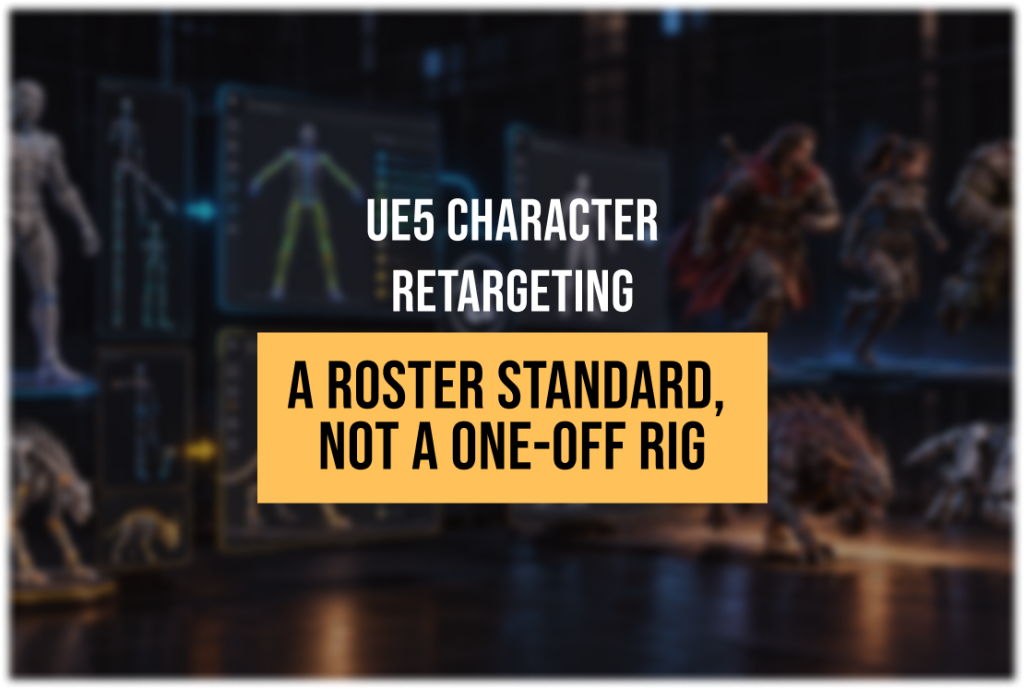
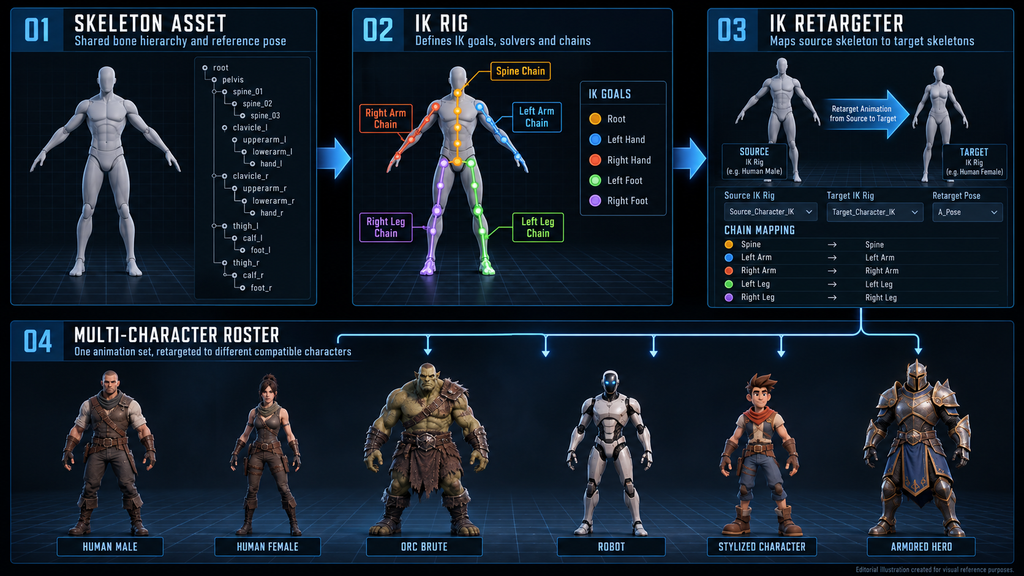
For roster planning, it helps to separate three layers regardless of which workflow a project standardizes on. The Skeleton asset defines a character’s bone hierarchy directly; characters built on the exact same Skeleton asset get the simplest animation-sharing case, and Epic’s own documentation shows this working across meaningfully different proportions – a base character, a short stocky variant, and a tall skinny variant, all still on one Skeleton asset. The IK Rig works from the character’s skeletal hierarchy and can define IK Solvers and Goals for general pose editing, plus – specifically for retargeting purposes – a set of Retarget Chains that identify which bone groups on a given skeleton correspond to which body regions. The IK Retargeter is the asset that connects a source IK Rig to a target IK Rig and performs the actual retargeting between them.
“Editorial illustration created for visual reference purposes. It does not represent a real project, client work, or official software screenshot unless stated otherwise.”
For a large roster, the practical decision is which layer to standardize on early. Characters that can share one Skeleton asset get the simplest setup, and – as Epic’s own examples show – “simplest” can still cover a meaningful range of proportions. Once a roster needs characters whose skeletal structures are no longer compatible with that shared standard, the IK Rig and IK Retargeter workflow is the more flexible modern option for keeping animation sharing intact across that variation, provided the source and target anatomy can be mapped into meaningful corresponding retarget chains.

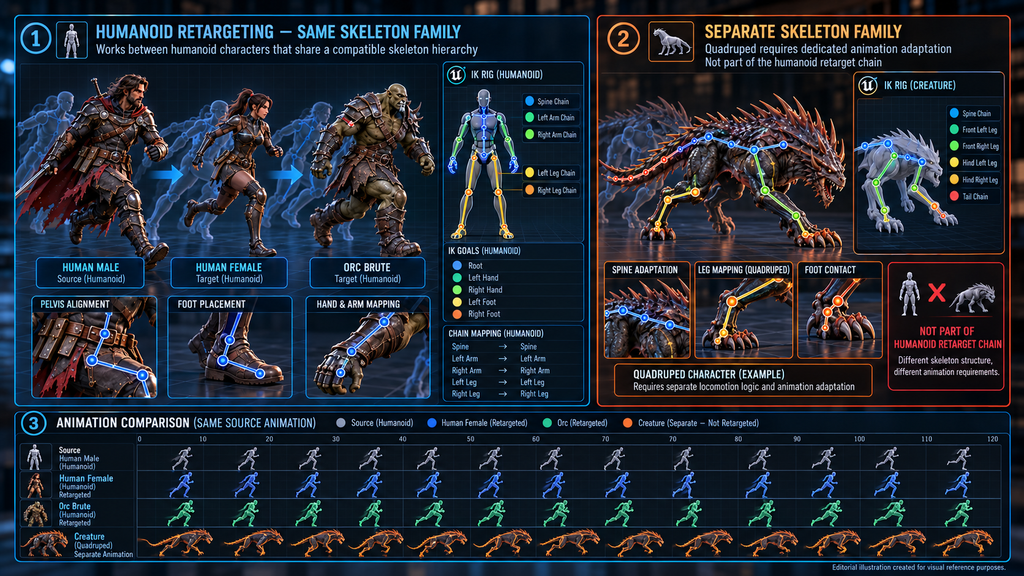
The distinction that matters here isn’t proportion – Unreal’s retargeting tools are built specifically to absorb proportion differences on a shared skeleton. It’s whether two Skeletal Meshes can reasonably use a compatible Skeleton asset and hierarchy for the project’s needs. Once characters require genuinely incompatible skeletal structures or fundamentally different body plans – not just a wider range of proportions – separate Skeleton assets and a cross-skeleton retargeting workflow become the appropriate approach, rather than stretching one shared standard to cover anatomy it wasn’t built for.
Even then, IK Rig retargeting doesn’t automatically make animation semantically appropriate across radically different body plans. Skeleton families can be useful for structurally different anatomies – a humanoid family and a quadruped family, for instance – and IK Retargeters can connect compatible motion between them where a meaningful chain correspondence exists. But a biped walk cycle and a quadruped gait are different locomotion structures, not just different proportions on the same motion, and sharing that kind of animation across families typically needs dedicated animation work or additional procedural adjustment rather than a retargeting setup alone.
“Editorial illustration created for visual reference purposes. It does not represent a real project, client work, or official software screenshot unless stated otherwise.”
This is a design decision worth making deliberately rather than discovering mid-roster. A cast that was assumed to be entirely humanoid at the start of production, and that later adds a creature or a heavily divergent body plan, is exactly the scenario where an undocumented rig approach turns into a rework pass – not because retargeting can’t handle the new skeleton, but because nobody planned which skeleton family it belongs to or whether its motion needs are compatible with what already exists.
Setting the Rig Standard Before the Roster Grows
The point in production where this pays off is early – around the same stage where a studio locks the broader 3D character pipeline for its first characters, rather than after several characters have already shipped against an ad hoc rig approach. A rig standard set at this stage should account for the range of body types the roster is expected to need, not just the first character built – which means art direction and technical art need to agree on that range before the first skeleton is locked, not after the fifth character reveals it doesn’t fit.
Getting this sequencing right doesn’t require guessing at every future character in detail. It requires a defined answer to a narrower question: what’s the widest range of proportions and bone-hierarchy variation this roster is likely to need, and does the planned skeleton family structure actually cover that range? A studio that can answer that question before scaling production is working from a standard. A studio that can’t is working from precedent, one character at a time.
MetaHuman as a Standardized Framework, Not a Solved Pipeline
MetaHuman is usually discussed as a character-creation tool, but its skeleton is also relevant here as a standardized character framework with documented Unreal Engine retargeting workflows, including dedicated support for retargeting animations to and from a MetaHuman skeleton. That’s a real advantage for a roster built on MetaHuman-compatible characters – it reduces how much custom rig infrastructure a studio has to design and validate from scratch. It does not mean the pipeline is “already solved”: animation quality, gameplay interactions, body variation beyond MetaHuman’s supported range, clothing and prop attachment, and project-specific retargeting setup still need validation on a studio’s own characters and content.
Neither a custom skeleton nor a MetaHuman-based standard is categorically right for a large roster – a heavily stylized cast with non-realistic proportions may fit poorly against a MetaHuman-derived standard, while a realistic or semi-realistic humanoid cast may find the standardized framework saves meaningful setup work. The decision is worth making explicitly, and validating on real content, rather than defaulting to whichever option came up first in a pipeline discussion.
Retopology’s Role in Clean Retargeting
Retopology doesn’t determine whether animations can be retargeted between characters – that’s governed by skeleton and rig setup, not mesh topology, and characters can use different topology while sharing the same skeleton and animation system. Where retopology matters to a retargeting conversation is deformation quality: a mesh with inconsistent edge flow around joints – the areas that actually deform under animation – can produce visible artifacts even when the retargeting setup itself is configured correctly, simply because the geometry wasn’t built to hold that deformation cleanly. For a large roster, this means defining deformation-quality expectations around major joints is worth doing alongside the rig standard, even though individual characters don’t need identical topology to share a skeleton or a retargeting setup.
Building This In-House or Bringing in a Rigging Partner
Whether a studio designs this rig standard with an internal technical artist or brings in outside help matters less than whether the decision gets made deliberately, with the full range of the roster’s body types considered, rather than emerging by accident from whichever character got rigged first. An internal team with strong technical art capacity can absolutely own this decision – the risk isn’t a lack of in-house skill, it’s a lack of dedicated time to plan the standard before production pressure pushes the team toward solving each character’s rig individually. Our comparison of hiring a 3D artist versus outsourcing to a studio covers the broader version of this decision; for a rig standard specifically, a partner brought in to define it is being asked a scoping question upfront, rather than a per-asset execution question, and that distinction is worth being explicit about in a brief if outside help is part of the plan.
Quick Diagnostic Questions
Worth answering honestly before committing a growing roster to a single rig approach:
- Do you know the full range of body types and proportions your roster is expected to need, or only the ones already built?
- Is your current skeleton standard documented somewhere a new rigger could follow, or does it exist mainly as precedent from the last character?
- If a non-humanoid or heavily divergent character entered the roster tomorrow, do you know which skeleton family it would use?
- Have you evaluated whether a MetaHuman-based standard fits your cast’s style, or is a custom skeleton the default by inertia rather than by decision?
- Does your retopology convention around joints match what your rig standard actually needs, or were the two decided independently?
Getting the Pipeline Right Before the Roster Grows
A retargeting setup that works for one character and a rig standard that scales across a growing roster are solving related but distinct problems, and treating them as the same task is where multi-character pipelines tend to accumulate rework. Defining a skeleton and rig-family standard against the roster’s expected range of body types can reduce how often the same rigging and retargeting decisions have to be re-solved character by character.
If your project is scaling a character roster in UE5 and you’re not confident the current rig approach holds up across the full range of characters it needs to support, we can review the pipeline, identify compatibility and scaling risks, and scope what needs to be standardized before the roster grows further.