How AAA Teams Work With a Vehicle Art Partner
-

Written byDenys Zadoienyi
-

Updated on13.11.2026
-

Time to read7 min

- Agree Who Owns the Vehicle Art and the Vehicle System
- Give Every Spec Decision an Owner
- Review Vehicle Art at Game Scale
- Run One Integration Review With Two Acceptances
- Keep the Fleet Consistent Across Artists
- Vehicle Art Case Examples
- A Vehicle Agreement, Filled In
- Our Approach
- Request a Vehicle Art Quote
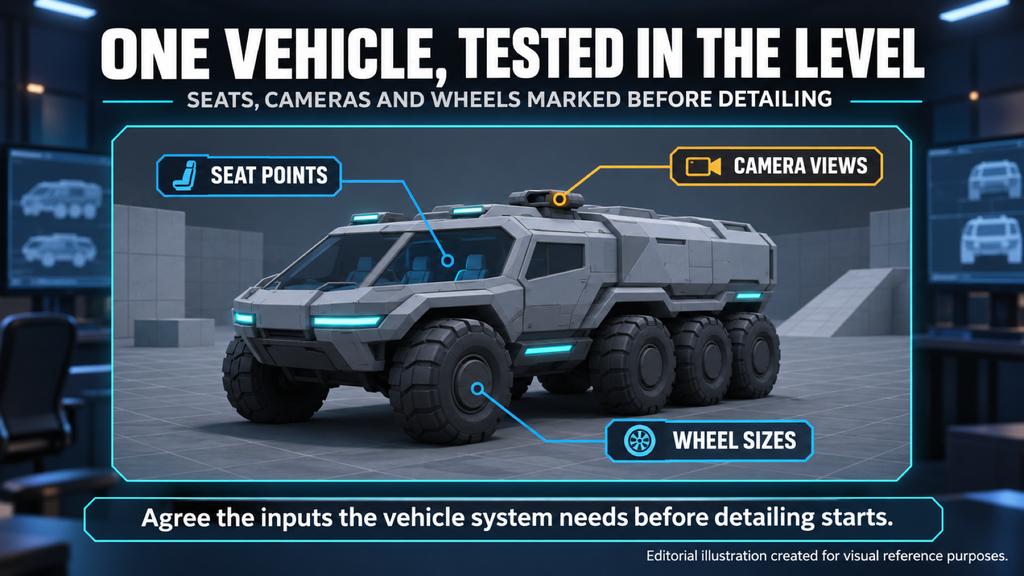
Outsourced vehicle art in AAA games works best when both teams agree, before modeling begins, what the partner delivers and what the studio integrates. Give each decision an owner, then record two separate checks: one that closes the art handoff and one that closes integration in the game build.
“Editorial illustration created for visual reference purposes. It does not represent a real project, client work, or official software screenshot unless stated otherwise.”
Art handoff is complete when the delivered files meet the agreed requirements and pass the checks assigned to the partner. Integration is complete when the team responsible for the game build verifies the vehicle in its intended use – for a playable transport, entering it, driving it and viewing it from the required cameras.
Agree Who Owns the Vehicle Art and the Vehicle System
“Editorial illustration created for visual reference purposes. It does not represent a real project, client work, or official software screenshot unless stated otherwise.”
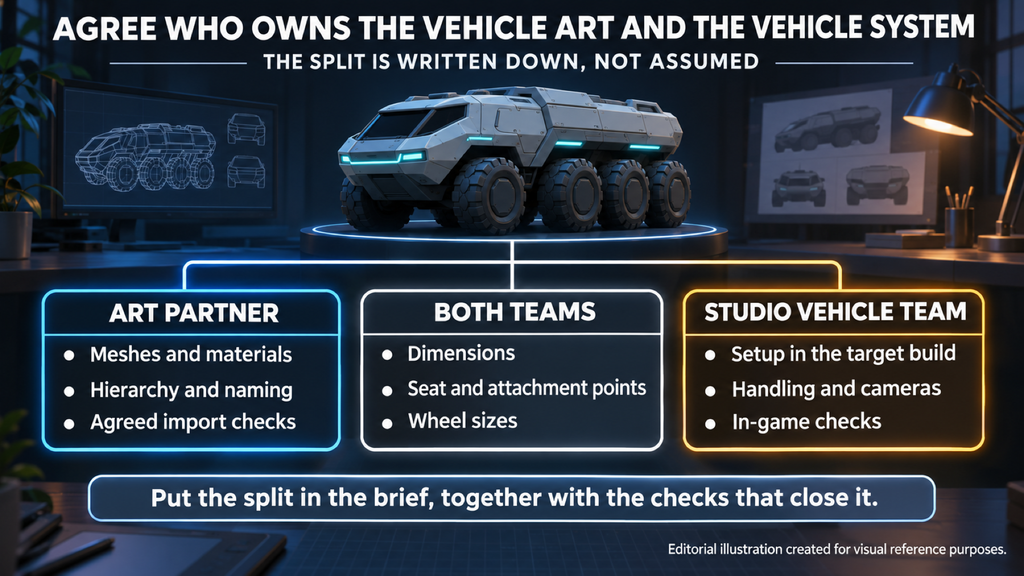
Before blockout, record what the art partner delivers, who connects the asset to the game and which inputs both teams must match. The split varies by contract, so write it down rather than assume it.
Vehicles make this boundary easy to see. In Unreal Engine’s Chaos Vehicles, a drivable vehicle is set up from a skeletal mesh together with engine-side assets such as a physics asset, a vehicle blueprint and wheel blueprints, and the wheel radius configured for each wheel has to match the size of the visual model, according to Epic’s guide to setting up vehicles. A number like that is defined by the art and used by the system, so one person approves it and another verifies it in the build.
- Art partner: the agreed meshes, materials, hierarchy and naming, plus any import checks included in the scope.
- Studio vehicle team: setup in the target build and in-game checks for the functions assigned to it, such as handling and cameras.
- Both teams: dimensions, attachment and seat points, wheel sizes and any other inputs the vehicle system expects from the art.
Some studios want the partner to go further into engine setup; others keep everything after the mesh in-house. Either works when the split is in the brief together with the checks that close it.
Give Every Spec Decision an Owner
Start with the decisions that can change the delivery. Record who approves each one and which revision they approved.
Our guide on what to lock in a vehicle spec covers the contents of the brief. Ownership is what keeps it stable: a decision without an owner tends to reopen after detailing has started, which means a repeat review for the producer and rework for the technical lead.
- Art director: silhouette, proportions, materials and fit with the fleet.
- Technical art lead: naming, hierarchy and delivery requirements.
- Vehicle or gameplay lead: player interactions, gameplay cameras and clearances.
- Producer: scope, priorities and changes to approved requirements.
Gameplay keeps changing after approval. If the studio adds a seat after the blockout is approved, the producer logs the change, checks which reviews must reopen and confirms the revised brief with the partner before work continues – the route described in our guide on how to contain art scope creep.
Review Vehicle Art at Game Scale
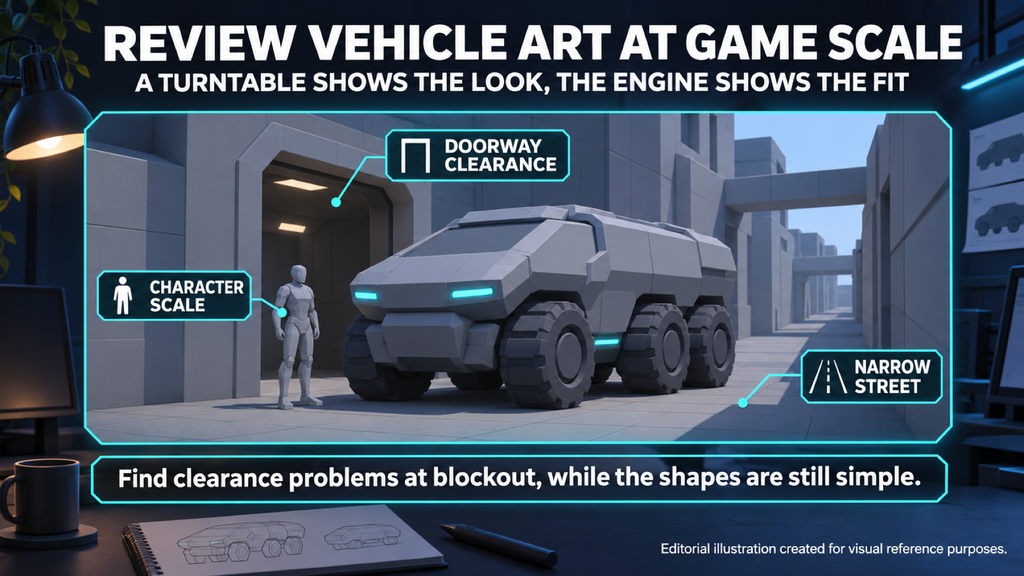
“Editorial illustration created for visual reference purposes. It does not represent a real project, client work, or official software screenshot unless stated otherwise.”
Agree who runs each check, what evidence they share and which decision closes each review. A turntable shows the look; scale, clearance and moving parts show up only in the engine.
- Blockout. The studio checks scale and clearance in a representative level. The vehicle lead records which dimensions the partner can use for detailed work.
- First engine import. The teams check the agreed hierarchy, moving parts and attachment points in the environment named in the brief. The technical art lead records any fixes the partner needs to make.
- Final review. The studio checks the vehicle in its intended game scenario. For a playable transport, this can include a short drive and a check of the agreed seats and cameras.
In a 2021 interview with 80.lv, CD PROJEKT RED’s Ben Andrews described making many 3D blockouts to test vehicles in the game environment so they fit the metrics of Cyberpunk 2077’s city. With an external partner, agree who produces comparable test evidence and when the partner receives it.
If you are an art director or technical art lead, protect the blockout review. A clearance problem found there changes simple shapes; found after detailing, it reopens high-poly work, bakes and UVs.
Run One Integration Review With Two Acceptances
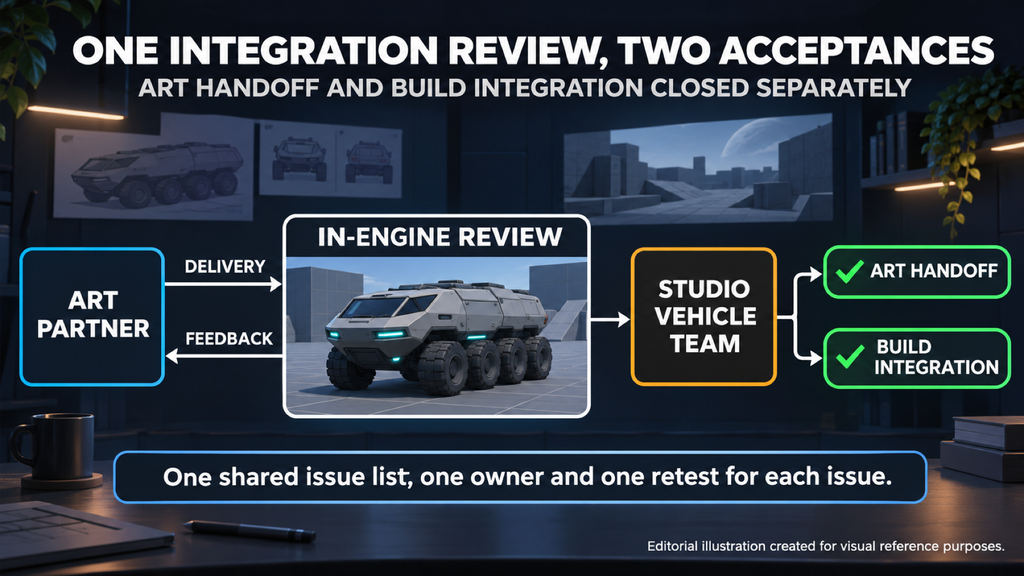
“Editorial illustration created for visual reference purposes. It does not represent a real project, client work, or official software screenshot unless stated otherwise.”
The partner submits the files and the evidence for the agreed import checks. The studio connects the asset to the target build and tests the agreed player interactions. One shared issue list keeps both teams on the same revision.
For each issue, record the build and asset revision, a short capture, the expected result, who fixes it and who retests it. Route an art issue to the partner and a system issue to the studio team when that is the agreed split; if the cause is unclear, both leads confirm ownership before anyone starts work.

As a producer, close the two acceptances separately. Close the art handoff once the agreed deliverables pass their checks. Close integration once the studio verifies the relevant in-game behavior. Record any deferred issue with a named owner and an explicit decision to accept it for the current milestone.
Keep the Fleet Consistent Across Artists
A fleet stays consistent when every vehicle is judged against the same references, not when vehicles are corrected one by one at the end.
Review each new vehicle next to an approved reference at the same camera distance. Keep the references, material and wear rules and naming in the art bible or another shared document both teams can open, and ask the art director to record each approved exception so the next artist applies the same decision.
Vehicle Art Case Examples
For Squad, Offworld Industries’ tactical shooter built around 100-player, combined-arms battles, Nasty Rodent produced final assets for vehicles and weapons.
The two projects differ in genre and in how players use vehicles; in both, the delivered assets had to align with the client’s technical requirements and visual style.
For Corruption 2029, The Bearded Ladies’ turn-based tactical game, our focus was realistic vehicles and weapons aligned with the project’s technical requirements and visual direction.
A Vehicle Agreement, Filled In
This example assigns owners and acceptance checks for a fictional playable transport in a team shooter.
Illustrative example, not a client project. Decisions describe this fictional assignment only.
| Decision | Owner | Agreed requirement | Evidence |
| Art delivery | Art partner lead | Exterior mesh, materials and agreed part names delivered for the engine version in the brief | Asset revision and import capture |
| Scale and clearances | Studio vehicle lead | Blockout fits the reference character and clears the narrowest route on the test map | Approved blockout capture |
| Seats and cameras | Studio vehicle lead | Driver and two passenger seats work under the approved camera views | Test capture from each required view |
| Scope change | Producer | A seat added after blockout approval triggers a brief update before detailing resumes | Approved change record |
| Art handoff | Studio technical art lead | Delivery matches the approved brief and passes the agreed import checks | Art acceptance recorded against the asset revision |
| Build integration | Studio vehicle lead | Vehicle can be entered, driven along the test route and viewed from the agreed cameras | Integration acceptance recorded against the build revision |
Our Approach
For 3D vehicle production for games, we work to the naming, hierarchy and delivery requirements you share. When we take over a fleet already in production, we start with one vehicle to confirm how the assets fit your pipeline before scaling up. Tell us which engine checks you want included when you request an estimate.
Request a Vehicle Art Quote
Send us your vehicle list, target engine and any references you already have, and tell us which parts of production you want the art partner to own so we can estimate that scope. The initial consultation is free.
Write to sales@nastyrodent.com or use our contact form. We usually reply within 1–2 business days.
Let's work
together
in mind?
From 3D characters and environments to weapons, props, concept art and game UI/UX: ten years deep, 40+ artists strong, zero fluff. Tell us what you are making and get a free, no-pressure estimate.
estimate