3D Environment Art Scope Estimation: From Brief to Asset List
-

Written byDenys Zadoienyi
-

Updated on21.08.2026
-

Time to read17 min

- The gap between a brief and an asset list
- A category framework built for environments specifically
- Breaking the location into modules
- Counting unique elements separately from repeats
- Turning the zone inventory into an asset list
- Turning the counted list into an environment art estimate
- Sizing the contingency buffer
- A worked example, to show the method — not a benchmark
- Common mistakes in environment scope estimation
- What we need to estimate your environment
- About Nasty Rodent
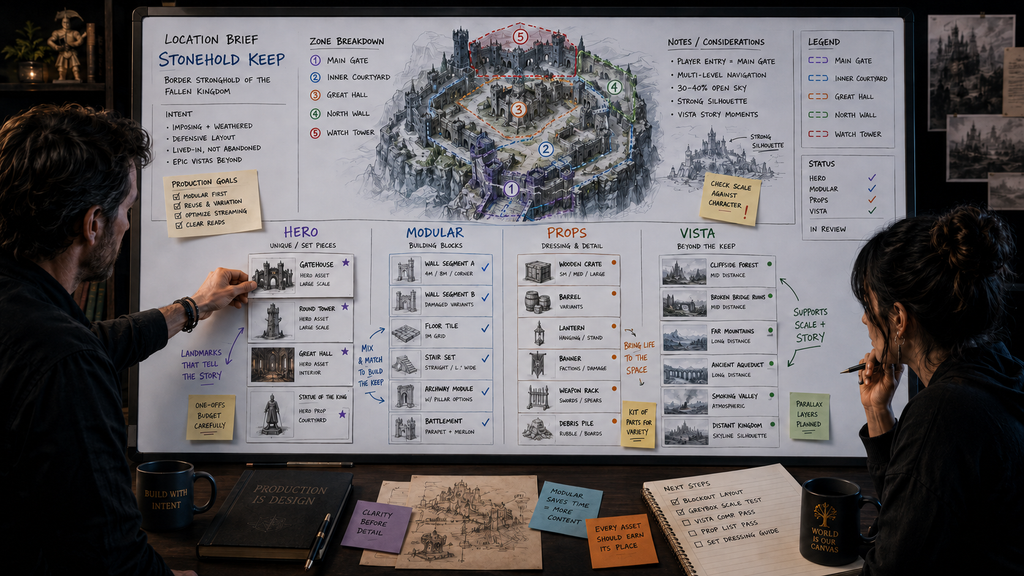
A location brief tells you what a space is for. It does not tell you what to build. “An abandoned market square, post-collapse, three approach routes” is enough to brief a concept artist — it is not enough to schedule a team, because it contains no count. Turning that sentence into a number a producer can plan against and an art director can hand to a kit artist is a separate step, and it has a method: break the space into modules, sort what’s inside each module by role, count what’s unique separately from what repeats, and size a contingency for what the brief still leaves open. This article walks through that method directly, not the theory behind modular design.
“Editorial illustration created for visual reference purposes. It does not represent a real project, client work, or official software screenshot unless stated otherwise.
The gap between a brief and an asset list
A well-written brief answers narrative and gameplay questions: what happens here, what mood it carries, how the player moves through it, what the reference package looks like. We’ve covered what a production-grade brief itself needs to contain in a separate guide — scope definition, technical spec, milestone structure, revision protocol. That article is about what goes into the document. This one starts from the assumption that the document already exists, and answers a different question: given this brief, what is the actual list of things that need to be modeled, and how many of each.
That gap is where first-pass environment estimates often become unreliable. A brief can be excellent — clear narrative intent, strong references, a locked art direction — and still not contain a single number an art director can schedule against, because narrative intent and a production count are different documents produced by different thinking. Writing the brief is a creative and technical-spec exercise. Turning it into an asset list is a counting exercise, and treating it as an extension of the writing (rather than a distinct pass with its own method) is how “one location” quietly becomes an unscoped, unbounded commitment.
A category framework built for environments specifically
Before counting anything, every element the brief implies needs a role. A useful place to start is a categorization built specifically for environments — distinct from how a character or prop list gets sorted, because an environment has a category no other asset type does: the things the player sees but never approaches.
A practical framework for this comes from senior environment artist Daniel McGowan, writing for 80.lv: he groups scene assets into four broad categories that cover most of what a location brief will imply. It’s one practitioner’s working framework, not a formal industry standard — studios frequently split vegetation, terrain, decals, or shared material systems into their own production groups on top of it — but it’s a solid first pass for sorting a brief before counting anything:
- Hero assets — the centerpiece objects the camera lingers on and the player interacts with closely. These are typically fewer in number than Modular or Prop assets, and they often carry the highest production cost per unit because they need clean silhouettes at close range and, where interactive, additional technical setup.
- Modular assets — the structural workhorses: walls, floors, ceilings, architectural kit pieces that combine to build the volume of the space. A single modular set typically does most of the square-footage work in an environment.
- Props — the objects that populate and inhabit a space without defining its structure: furniture, clutter, interactive set-dressing.
- Vista assets — geometry the player sees but never reaches: distant skylines, matte-painting-style backdrops, anything read from a fixed distance rather than approached. McGowan notes these typically get the smallest share of the polygon budget precisely because they’re never inspected up close — though a lighter geometry budget doesn’t mean lighter production cost, since a vista’s concept, composition, and lighting integration still take real work.
This categorization matters for counting because each category is counted differently. Hero assets are counted one by one, by name. Modular assets are counted as unique pieces in a kit, independent of how many times each piece gets placed. Props need two separate counts, covered below. Vista assets are usually a small number of large, distance-specific pieces rather than a long list. A brief that just says “environment assets” without this sort applied is a brief that hasn’t actually been scoped yet — it’s been described.
Breaking the location into modules
With the category framework in hand, the first structural pass is decomposition: taking the space the brief describes and breaking it into the physical modules that will actually get built.
This starts with the brief’s own geography. Most location briefs already imply zones, even when they don’t say so explicitly — “three approach routes” in the market square example already implies at least three distinct spatial segments, each of which will need its own pass. Walk the brief the way a level designer would walk the space: entry points, connecting corridors or open areas, focal points, exits. Each zone gets its own module inventory before the whole list gets combined.
Within a zone, the modular kit itself follows a grid logic that determines how many unique pieces are actually needed versus how those pieces recombine. Polycount’s reference on modular design puts the core principle plainly: modular pieces are built to a common pattern specifically so a small number of unique pieces can be reused many times to produce a large amount of visible variety. A kit built on a consistent grid — where every piece’s dimensions are a clean multiple of a base unit — is what makes that reuse possible; a kit where pieces don’t share a grid stops being modular in practice, even if it was designed with modularity in mind, because pieces that don’t align can’t recombine cleanly.
The practical output of this pass is a kit list, not a scene list: wall segment types, corner pieces, floor tiles, ceiling pieces, transition pieces (doorways, windows, archways), each identified once regardless of how many times it will appear in the finished space.

Counting unique elements separately from repeats
This is one of the steps that most strongly affects whether an estimate is realistic or inflated, and it applies across all four categories, not just Modular.
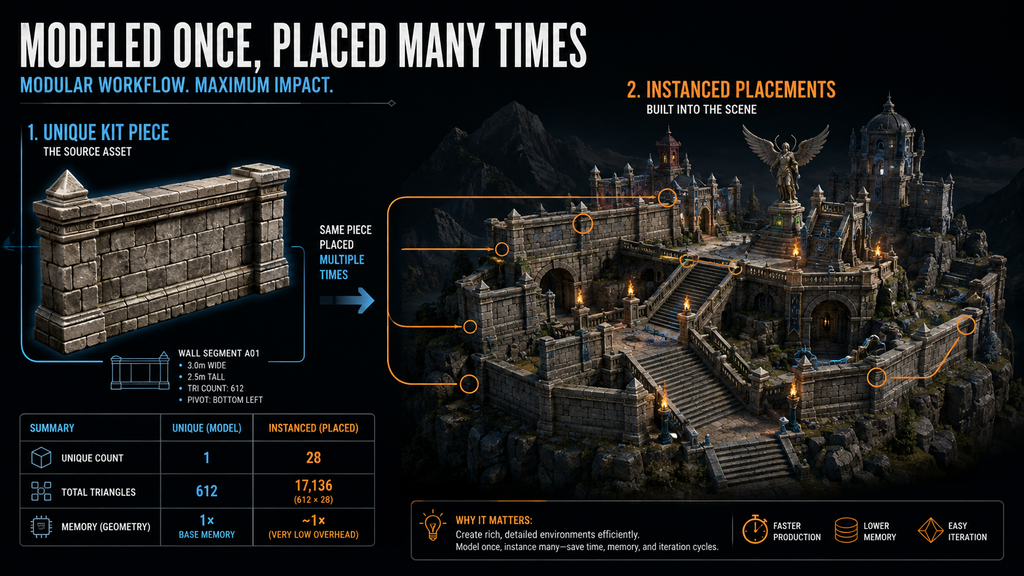
The rule is simple to state and easy to get wrong under brief pressure: a piece that will be placed forty times in the finished scene is one unique asset line item, not forty.
“Editorial illustration created for visual reference purposes. It does not represent a real project, client work, or official software screenshot unless stated otherwise.”
That single line item still carries its own full production chain — concept, modeling, UV, bake, texturing, collision, and integration — so “one line item” means one thing to produce, not one lightweight task. What varies by category is what “counted once” actually means:
- A Modular kit piece is modeled, textured, and validated once. Its forty placements are level-design and set-dressing work — real work, but a different kind of work than modeling, and it belongs in a different line of the estimate, not folded into “forty wall segments.”
- A Prop needs two separate counts: an exact count of unique types that must be produced, and a separate instance band for how many times those types get placed. A brief describing “a market stall selling produce” doesn’t need twelve unique crate models — it needs one or two crate types (the unique count driving modeling work) placed across a dozen-plus instances with a variation strategy (material swaps, minor scale changes, weathering decals) to avoid visible repetition. Both numbers belong in the estimate; only the first drives modeling.
- A Hero asset is defined by camera proximity, gameplay interaction, and narrative weight — not by how many times it repeats. A repeated object can still need Hero-level treatment if the player approaches and reads it as a major anchor each time; instance count is a reason to double-check the tier assignment, not to override it.
- A Vista asset is often built once and reused across multiple viewing angles or distances, sometimes with simple recoloring or repositioning rather than new geometry.
The failure mode to watch for is the opposite of over-counting: teams that correctly avoid counting the forty wall placements as forty models sometimes swing too far and drop the placement, variation, and validation work from the estimate entirely, as if reuse made it free. It doesn’t. A modular kit still needs a set-dressing and validation pass across every zone it appears in, and that pass scales with the space, not with the kit’s unique piece count.
Turning the zone inventory into an asset list
With categories assigned and unique-versus-repeat counts established per zone, the pass that produces the actual production list is straightforward, but it has to happen in this order — category, then count, then list — rather than starting from a list and trying to sort it afterward.
For each zone identified in the location breakdown:
- List every Hero asset by name, with a one-line note on why it’s Hero (camera proximity, gameplay interaction, narrative weight)
- List the Modular kit pieces the zone needs, checking first against kit pieces already listed for other zones — a well-scoped location reuses its own kit across zones rather than growing a new kit per zone
- List Prop types with an exact unique count per type, plus a rough instance band for how many times each type gets placed
- List Vista needs only where the zone actually has a sightline that requires them
Then consolidate across the whole location:
- Merge duplicate Modular and Prop entries that appeared in more than one zone’s list — this is usually where a first-draft count shrinks the most, because zones drafted independently tend to invent slightly different versions of the same kit piece
- Flag anywhere the brief doesn’t give enough information to assign a category or a count confidently — an undecided material direction for a kit, an unspecified prop density for a zone — rather than guessing a number to fill the gap
That flagged list of open questions is not a failure of the process. It’s the most useful output of a first estimation pass, because it tells you exactly what still needs a decision before the number can be trusted — which is a more valuable deliverable to hand back to whoever wrote the brief than a single total that’s quietly built on assumptions nobody signed off on.
For projects where the location sits inside a larger technical pipeline — Nanite eligibility per category, engine-specific LOD rules — the counting method above feeds directly into that layer rather than replacing it. We’ve covered those UE5-specific decisions separately in our technical considerations guide for AAA environment art.
For the broader production pipeline this counting method feeds into — blockout, modular kit build, optimization, engine delivery — we cover that end to end in our 3D environment design guide.
Turning the counted list into an environment art estimate
A counted asset list is the input to an estimate, not the estimate itself. Two locations can carry the same unique count — fourteen models, say — and represent completely different amounts of work: one built from an existing kit with trim sheets and locked materials already in place, the other requiring Hero elements from scratch, bespoke high-poly work, destruction states, and a material system that doesn’t exist yet. The count tells you what to build. It doesn’t yet tell you how much building that is.
For every line item on the counted list, the estimate needs:
- Starting point — built from scratch, adapted from an existing kit or library, or a polish-and-integrate pass on something that already exists. This single factor swings per-item cost more than category or count does.
- Complexity tier — whatever simple/standard/complex banding (or a studio’s own internal tiers) the item falls into, independent of its Hero/Modular/Props/Vista category — a Modular piece can be simple or complex just as easily as a Hero asset can.
- Required outputs — concept, high-poly, low-poly, UV, bake, texture, collision, LOD, engine-specific validation (Nanite eligibility, material instance setup), each only where the item actually needs it.
- Variation requirement — material variants, damage states, vertex paint, decal work needed to keep repeated instances from reading as identical.
- Review load — an individually-reviewed Hero asset costs more calendar time per unit than a Prop type approved as part of a batch.
Then add the systems and work that sit outside the per-item list entirely: a shared foundation pass (trim sheets, tileable materials, master material setup built once and used across many Modular and Prop entries), scene assembly and set dressing for the zone as a whole (placement, variation, decal work, lighting coordination — work that scales with the space, not with the unique count), and engine integration and QA (collision validation, LOD checks, a performance pass on the assembled scene).
The structure, without inventing numbers for it:
Environment scope effort = unique asset production + shared kit and material systems + scene assembly and set dressing + engine integration and QA + review and contingency.
Each studio fills the “unique asset production” line from its own delivered-project benchmarks per complexity tier and starting point — that’s data no general framework can substitute a number for without inventing one. What the structure above does is make sure nothing gets left off the list before those benchmarks get applied: a visually complete asset count with no line for assembly or integration is not yet a production estimate, even once every model on it has a cost attached.
Sizing the contingency buffer
No first-pass asset list survives contact with production unchanged, and pretending otherwise is how a scoped estimate turns into a broken promise at the first milestone review. The question isn’t whether to add contingency — it’s how to size it based on something more concrete than habit.
Contingency size should track the impact and dependency level of what’s still unresolved, not just how many open questions the consolidation pass flagged — one unresolved question about the core art direction carries more risk than five small unresolved questions about individual prop variants, even though the second brief technically has more open items:
- A brief with a locked art direction, an existing kit to build from, and no open category questions carries the least risk — contingency here mostly covers ordinary production variance, not scope uncertainty.
- A brief describing a new visual direction, a kit built from scratch, or unresolved questions that touch core categories rather than individual items carries meaningfully more risk, because “unresolved” at brief stage routinely becomes “discovered mid-production,” and discoveries mid-production cost more than the same decision made at the estimation stage.
- A brief where zone descriptions were clearly written independently (the market square’s three approach routes sketched by different people, for instance) tends to hide duplicate or near-duplicate Modular pieces that the consolidation pass catches on paper but that inflate the count if consolidation is skipped.
- Factors outside the brief itself also belong in the sizing decision: whether the pipeline or engine version is new to the team, how many approval layers the client side has, and how reliable any existing kit or asset library the estimate assumes actually is.
Rather than publishing a single contingency percentage as if it applied uniformly to every project, the more defensible move is to size it against a studio’s own delivered-project data, weighted by the number, impact, and dependency level of what the specific brief leaves unresolved — the same logic that governs any production estimate built on incomplete information. It’s the same discipline we apply to scope estimation generally in our breakdown of game development cost: a number earned from the specifics of the project, not assumed from a habit.
A worked example, to show the method — not a benchmark
The counts below are illustrative only, built to demonstrate the process on a small, self-contained space. A dense urban block, a sprawling open-world biome, and a single interior would each produce entirely different lists from the same method.
Take a brief describing a single-zone interior: an abandoned market hall, one main space with a mezzanine level, three stall alcoves along one wall, and a collapsed section serving as the player’s entry point.
| Category | Line item | Unique count | Notes |
| Hero | Collapsed entry archway | 1 | Camera-anchored first impression of the space |
| Hero | Central market fountain (dry, damaged) | 1 | Interactive focal point, gameplay cover |
| Modular | Wall kit (base panel, corner, damaged variant) | 3 pieces | Reused across the full perimeter and mezzanine supports |
| Modular | Mezzanine floor and railing kit | 2 pieces | Reused across the upper level |
| Props | Stall structures (3 alcoves) | 2 unique types | Two stall variants, recombined with material swaps across three alcoves |
| Props | Market debris set (crates, baskets, cloth) | 4 unique types | Scattered throughout via placement and rotation variation |
| Vista | Distant collapsed ceiling / sky opening | 1 | Seen from below, never approached |
| Shared system | Trim sheet and tileable material set | 1 set | Not a model — used across walls, mezzanine, and stalls |
| Production task | Scene assembly and set dressing | 1 zone | Placement, variation, decals, and lighting coordination across the whole space |
| Production task | Engine integration and QA | 1 pass | Collision, LOD and material validation, final performance check |
Fourteen unique models across seven asset line items, plus the shared material system and the two zone-level production tasks that turn those models into the actual playable space. Described loosely, this same room could easily have been quoted as “twenty to thirty assets” by someone counting placements instead of unique production work — and just as easily under-quoted by someone who counted the fourteen models and stopped there, without the assembly and integration work the space still needs on top of them. The gap in both directions is the entire point of running the method instead of estimating from a gut read of the brief.
One note on using a table like this for the next step: grouped rows such as the wall kit’s three pieces or the debris set’s four types are grouped here for scope readability, not because they should be estimated as a single unit. In the production worksheet, a grouped row gets expanded one level further wherever its individual pieces carry different starting points, complexity tiers, or deliverables — a damaged wall variant and a base wall panel are one line item above, but likely two different entries once starting point and complexity get assigned.
Common mistakes in environment scope estimation
- Counting placements instead of unique models — a common source of inflated first-pass numbers, and the mirror-image mistake of dropping placement and validation work from the estimate entirely
- Drafting each zone’s kit list independently without a consolidation pass, which duplicates Modular pieces that should have been shared
- Treating every distinctive object as Hero tier because it stands out in the brief’s description, rather than checking it against camera proximity and gameplay role
- Skipping the Vista category entirely because it feels like an afterthought, then discovering late that a sightline the brief implied has no geometry behind it
- Applying a flat contingency percentage regardless of how many open questions the brief actually leaves unresolved, which either pads a well-scoped project unnecessarily or under-protects a genuinely uncertain one
What we need to estimate your environment
The single most useful thing a producer or art director can send us is the zone-by-zone breakdown above, even in rough form. Send these and you get a real production number instead of a range.
| We need | Why it changes the estimate |
| The location brief and any zone breakdown already done | Defines how much of the counting pass is already complete |
| Existing kit, material library, or art bible | Whether Modular work starts from zero or builds on a foundation |
| Reference for Hero elements specifically | Hero assets carry the most cost variance per unit |
| Target engine and platform | Unreal Engine 5 or Unity, and the performance envelope the space has to run in |
| Which open questions from your own pass are still unresolved | Directly shapes how much contingency the estimate needs to carry |
| Deadline | Determines how the list gets sequenced across a team, not just the total |
About Nasty Rodent
Nasty Rodent is a full-cycle game art studio (Nasty Rodent OÜ, Tallinn, Estonia) supporting mid-core and AAA teams across 3D environments, characters, props, weapons, vehicles, concept art, and UX/UI — including the exact brief-to-production handoff this method is built around. If your location brief needs a second, counted pass before it goes into a production schedule, send us your brief and we’ll come back with a categorized, scoped estimate.