How to Vet a Game Art Outsourcing Studio: 7 Checks Before You Choose
-

Written by Denys Zadoienyi
-

Updated on03.08.2026
-

Time to read14 min

- 1. Portfolio Fit – Beyond the Hero Shots
- 2. The Paid Trial Task – What It Actually Reveals
- 3. Technical Delivery – Engine-Ready vs. Render-Ready
- 4. Communication, Staffing, and Capacity
- 5. Revision Process and Quality Ownership
- 6. Reference Checks – Verifying What They Told You
- 7. NDA, IP Terms, and Security Readiness
By the time most producers start searching for “how to choose a game art outsourcing studio,” the bigger decision is already made. You’re not weighing outsourcing against building an internal team anymore – that comparison, including the case for building internal capacity, is covered in our hire vs. outsource guide. What’s in front of you now is a list of studios that all look competent on their landing pages, and a decision about which ones get your brief, your reference materials, and – eventually – your budget.
“Editorial illustration created for visual reference purposes. It does not represent a real project, client work, or official software screenshot unless stated otherwise.”
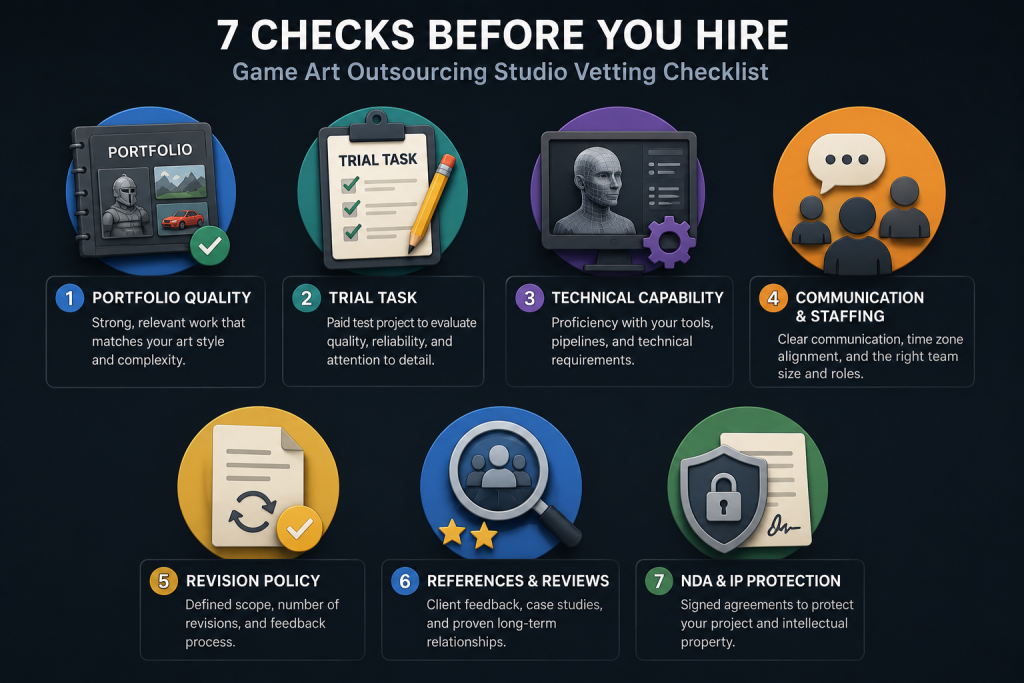
This checklist is for the stage after you’ve identified a longlist of plausible vendors but before you make a final selection. Where exactly it fits depends on how your team runs procurement: some run these checks before issuing an RFP, to narrow the field going in; others use RFP responses to build the shortlist first and reserve paid trials and reference calls for the final two or three candidates. Either sequence works – what matters is running all seven checks before a contract is signed, not which order you run them in. None of them are about whether a studio’s showreel looks impressive. Showreels are curated by definition – every studio’s is. What separates a reliable partner from an expensive mistake shows up in the details a showreel is never designed to reveal.
1. Portfolio Fit – Beyond the Hero Shots
A portfolio answers one question well and hides another. It tells you whether a studio can produce work at a certain quality bar. It tells you almost nothing about whether that quality bar holds across fifty assets on a real production schedule, not just the five best pieces a studio chose to lead with.
The fix is asking for production batches, not hero shots. A hero shot is the best single piece from a project. A production batch is a representative group of assets delivered together within the same milestone – the strong ones and the merely adequate ones, side by side. Consistency across a batch is a completely different signal than quality in a single frame, and it’s the one that actually predicts what your production will look like six months in.
Where client permissions allow, we favor walking prospective clients through representative production batches and case studies from shipped titles in our portfolio rather than isolated best-of pieces – because a single striking character render says very little about whether the next forty characters in a roster will hold the same bar. If a studio can only show you curated single pieces and can’t produce a batch view, that’s worth noting before you go further, not after.
Red flag: the studio can’t tell you which team members worked on a specific portfolio piece, or whether it was fully produced in-house versus subcontracted further down the chain.
2. The Paid Trial Task – What It Actually Reveals
A portfolio shows past work. A trial task shows how a studio behaves on your brief, under your constraints, right now. It’s one of the strongest validation tools available when the engagement is large enough to justify it – and it’s a step many buyers skip, usually because it feels redundant once the portfolio already looked good.
A pilot works best run after basic commercial, legal, and portfolio screening, with a defined scope, timeline, acceptance criteria, ownership terms, and an explicit agreement that the task is evaluative rather than unpaid production work. Keep it small and specific: one asset, close to your actual production scope, with a real deadline. What you’re testing isn’t whether the studio can produce something impressive – most can, given enough time. You’re testing whether they ask the right clarifying questions before starting, whether they hit the deadline they agreed to, and whether the delivered file actually matches your technical spec.
It isn’t universally necessary – for a smaller engagement, or a vendor with directly comparable shipped credits you can verify another way, a pilot may not be worth the calendar time it costs both sides. It’s most valuable for large, long-running, technically sensitive, or style-critical engagements, where the cost of a poor vendor fit is much higher than the cost of a small, paid pilot. On our own onboarding process, a small paid test is a common early step before a full-scale engagement begins, precisely because a real deliverable under real constraints surfaces pipeline mismatches a phone call never will. If a vendor declines a pilot, ask for the reason and weigh the alternative evidence they can offer instead – comparable production batches, technical sample files, a live pipeline walkthrough, or a structured calibration milestone early in the contract.
Red flag: the vendor won’t define scope, timeline, acceptance criteria, or ownership terms for a proposed pilot, or proposes it as open-ended unpaid production work with no clear IP or usage boundaries.
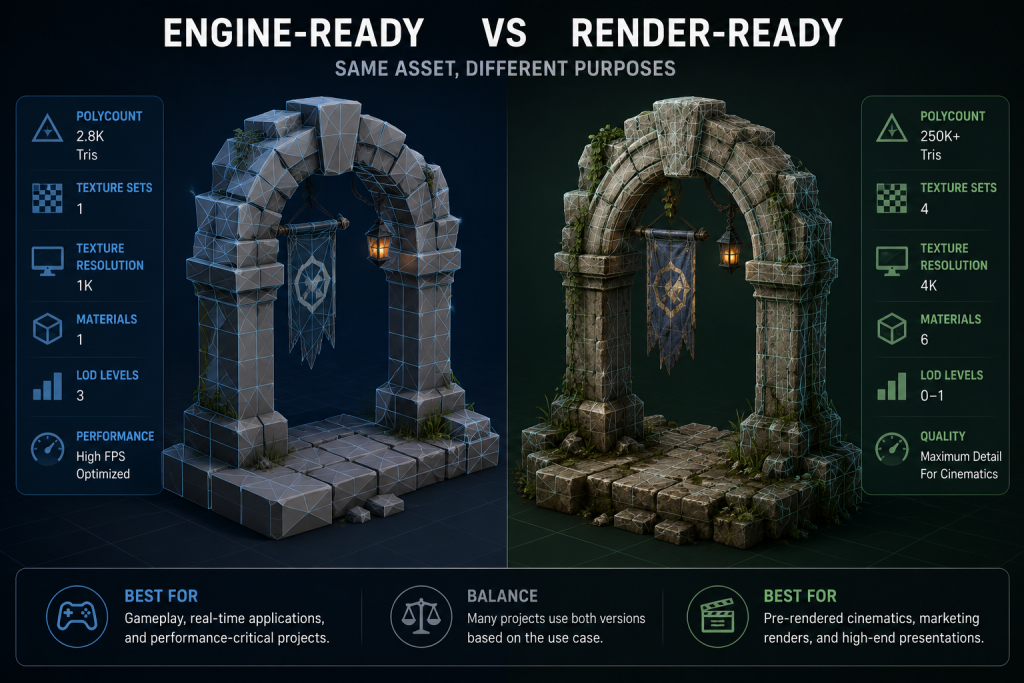
3. Technical Delivery – Engine-Ready vs. Render-Ready
This is where a lot of vetting processes quietly fail, because the failure isn’t visible until assets hit the engine. A model that looks flawless in a turntable render can still arrive with incorrect material setups, missing LODs, or a UV layout that breaks the moment it’s imported. Render-ready and engine-ready are not the same deliverable, and a studio’s marketing rarely distinguishes between them.
“Editorial illustration created for visual reference purposes. It does not represent a real project, client work, or official software screenshot unless stated otherwise.”
Ask directly: does the studio deliver assets validated in-engine, or does validation happen on your side after delivery? Ask whether LODs are required for your project, how many levels, whether they’re authored manually or generated, who validates them in-engine, and whether that work is included in the quoted scope – LOD strategy depends heavily on your target platform and engine setup (a Nanite-based UE5 pipeline, for instance, often needs none of this the way a traditional pipeline does), so the goal is a defined scope, not an assumed default. If your project uses UE5 specifically, our UE5 character pipeline breakdown shows what a complete, validated handoff actually includes stage by stage – a useful reference point for judging whether a vendor’s answer is specific or vague.
This specific check applies to real-time 3D production. Concept art has a different technical bar entirely – evaluate it on production usability instead: orthographic coverage, material and construction callouts, layer organization, scale references, and whether a 3D modeler could actually build from the deliverable without redesigning it. And if your primary need is UX/UI – interface systems, HUD, menu flows – the evaluation criteria shift again, which we’ve broken out separately in how to choose a game UX/UI design studio.
Red flag: vague or evasive answers about LODs, material setup, or export format – a studio with a mature pipeline can describe its process concretely, distinguish default scope from project-specific requirements, and point to a comparable engagement where those criteria were applied.

4. Communication, Staffing, and Capacity
A single point of contact who becomes unreachable mid-milestone is one of the most common ways an outsourcing engagement quietly stalls. Ask who you’ll actually talk to day-to-day, what happens when that person is unavailable, and how much working-hour overlap exists between your team and theirs. With little overlap, a clarification missed by a few hours can add a full business day to the feedback loop – across repeated review cycles, that adds up materially unless the vendor has strong asynchronous handoff practices. Being based in Tallinn gives our team substantial working-hour overlap with Western Europe and a workable scheduled window with parts of North America, depending on the client’s timezone and agreed communication hours – our breakdown of geography as a production variable goes deeper into why this affects more than just meeting times.
Portfolio and trial task both demonstrate what a studio can produce. Neither confirms who will actually be assigned to your project, or whether that team is available on your dates. Ask directly: who is allocated to this engagement, are those people confirmed for the proposed timeline, which roles are named versus provisional, and what – if anything – may be subcontracted further down the chain. A studio that pitches with senior talent and then staffs the actual production with a different, less experienced team is one of the more common gaps between the sales conversation and what production actually delivers.
Red flag: “all communication goes through one person” with no answer for backup coverage, or a vendor that presents a senior pitch team but can’t confirm who will actually produce and review the work once the contract is signed.
5. Revision Process and Quality Ownership
Ask a simple question: who owns quality control on this engagement, and what happens when a delivered asset doesn’t meet the brief? A studio with a mature process names a specific role – not “the team,” not “we’ll coordinate internally.” Vague ownership at the vetting stage tends to become slow, circular revision cycles once production is underway, because nobody is accountable for closing the loop.
It’s also worth asking how many revision rounds are included by default and what triggers a change order versus a covered revision. We treat this as a scope question that belongs in the brief and the SOW, not something negotiated milestone by milestone after friction has already started – ambiguity here is one of the most expensive gaps in a game art outsourcing engagement, expensive enough that it’s worth resolving before signing rather than during a dispute.
Red flag: the studio can’t name who owns revision sign-off, or can’t describe any mechanism – fixed rounds, capacity limits, or defined change-control triggers – that distinguishes defect correction from a normal iteration or a scope change.
6. Reference Checks – Verifying What They Told You
A portfolio and a trial task tell you what a studio can produce. A reference call tells you what it’s actually like to work with them under pressure – a missed deadline, a scope change, a disagreement about whether a delivered asset met the brief. Ask a prospective vendor to connect you with a past client on a project of similar scope and genre to yours, and ask that client directly how disputes were handled, not just whether the final art looked good.
Studios with a real production track record – including titles you can see on our own projects page, like Squad or Ready Or Not – can generally point to verifiable evidence of past work. A live reference call isn’t always possible: some clients restrict vendor references entirely, don’t want sales calls, or only permit them late in a prospect’s own procurement process – and a vendor can’t unilaterally waive another client’s confidentiality to arrange one. Reference calls, when they do happen, should be arranged with the former client’s explicit permission and generally reserved for serious, late-stage prospects rather than distributed freely. The actual red flag isn’t a declined reference request – it’s the absence of any independently verifiable evidence to substitute for it: public credits, approved case studies, named-role testimonials, or a production batch you can review directly.
Red flag: the vendor can’t offer a live reference, public credits, case studies, or any other independently verifiable evidence of past work – not confidentiality itself, but the absence of anything that substitutes for it.
7. NDA, IP Terms, and Security Readiness
Before any real reference material or brief leaves your hands, a studio should be ready to move quickly on confidentiality – and it helps to be clear that NDA and IP assignment are two different documents doing two different jobs. An NDA governs confidentiality: what counts as confidential information, who’s allowed to see it, how long the obligation lasts, and what happens to materials when the engagement ends. It says nothing about who owns the work produced.
Ownership of deliverables, source files, and reuse rights is a separate question, typically addressed in the MSA, SOW, or a dedicated IP-assignment clause – and the details genuinely vary by contract and jurisdiction. Rather than expecting one universal standard, ask specifically: which deliverables and source files transfer to you, when that transfer takes effect (on delivery, on acceptance, or on full payment), what happens to any pre-existing vendor tools or third-party assets used in production, and whether the vendor retains any portfolio or reuse rights. A studio that can answer this precisely – rather than gesturing at “standard terms” – has clearly been through this negotiation before.
Ask, too, about access segregation – whether only the team assigned to your project can see your files, and what happens to your materials if the engagement ends early. Many serious clients require the vendor to sign the client’s own NDA rather than the other way around, so the absence of a vendor-issued template isn’t itself a problem – what matters is how quickly and clearly the studio can move through whichever confidentiality process is in place.
Red flag: the vendor is slow or unwilling to execute an NDA before receiving confidential materials, can’t explain its access controls, or gives vague IP language with no clear treatment of source files, pre-existing materials, or subcontractors.
The Checklist at a Glance
| Check | What to Ask | Red Flag |
| Portfolio fit | Can I see a full production batch, not just hero pieces? | Can’t confirm who worked on a specific piece |
| Trial task | Can we run a small paid pilot with defined scope and terms? | Won’t define scope/ownership, or treats it as unpaid production work |
| Technical delivery | Do you deliver engine-ready or render-ready assets? | Vague, non-specific answers on LODs, materials, export format |
| Communication & staffing | Who’s assigned to this project, and what’s our timezone overlap? | Senior pitch team, unconfirmed actual production team |
| Revision process | Who owns quality sign-off, and what triggers a change order? | No mechanism distinguishing defect fix, iteration, and scope change |
| Reference checks | Can you point me to verifiable evidence of past work? | No live reference, case study, or any other verifiable evidence |
| NDA and IP | What’s your NDA process, and when does IP ownership transfer? | Slow to execute NDA, vague on IP transfer or source files |
What Happens After Vetting
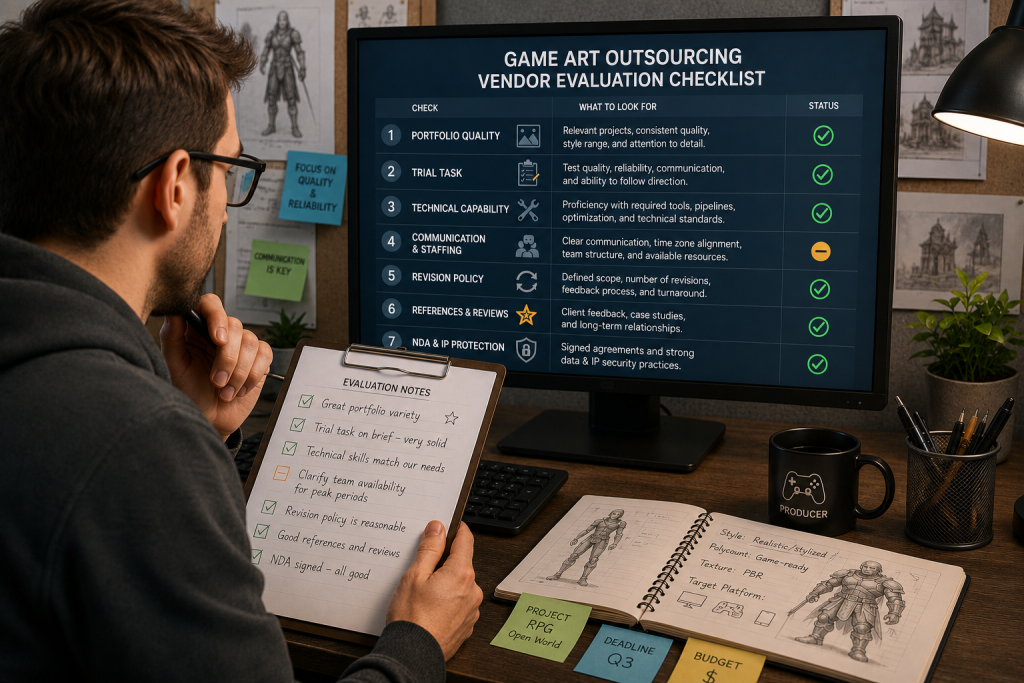
A vetting checklist narrows uncertainty, but where exactly it sits in procurement varies, as noted above. Some teams run a lighter version of these checks first, to decide which vendors even receive an RFP; others send the RFP first and use the checklist to evaluate the responses, reserving the pilot and reference calls for the final two or three candidates. Either way, this discipline isn’t new – a well-documented AAA case study on outsourcing Forza Motorsport’s art production walks through the same underlying principle: structure and vetting up front is what makes large-scale outsourcing hold together under a real deadline, not damage control after something breaks.
“Editorial illustration created for visual reference purposes. It does not represent a real project, client work, or official software screenshot unless stated otherwise.”
Whichever sequence you use, the evaluation should ultimately feed into a structured RFP, scoring matrix, and Statement of Work that make scope, deliverables, acceptance criteria, and commercial terms explicit rather than assumed.
After a vendor is selected and the SOW is signed, our 8-week vendor onboarding protocol covers what a structured kickoff actually looks like – the stage where a good vetting process either pays off or reveals what it missed.
About Nasty Rodent
Nasty Rodent is a game art outsourcing studio based in Tallinn, Estonia, working across 3D character, environment, prop, and weapon production, concept art, and UX/UI for mid-core and AAA titles. Where client permissions allow, we favor production batches and case studies over isolated hero pieces when walking prospects through past work, and for engagements where fit can’t be validated from shipped work alone, a small paid pilot is a step we use before scaling up – the same standard this checklist asks you to hold any vendor to.
Studios currently vetting outsourcing partners can review our 3D character production services directly.