Game Art Outsourcing Companies in 2026: 10 Studios Compared
-

Written by Denys Zadoienyi
-

Updated on04.08.2026
-

Time to read17 min

Search for game art outsourcing companies and you will find roughly a dozen lists, almost all of them written by studios that sell the same service. We checked seven of the highest-ranking ones in July 2026. Every one includes the studio that published it. Not one explains how the list was assembled, why the order is what it is, or where the numbers in each profile came from.
This is another such list, and it is also written by a studio that sells the service being compared. Nasty Rodent produces game art for mid-core and AAA projects, and we are on the list below. That is a conflict of interest, and pretending otherwise would be the least useful thing we could do for a procurement lead trying to build a defensible shortlist.
So here is the trade we are offering instead. We tell you how the ten studios were selected, we say where every figure came from and when it was checked, we put ourselves in the same template as everyone else, and we do not rank anybody. In exchange, you get something you can forward to a stakeholder without having to defend where it came from.
That last part matters more than it sounds. A shortlist that falls apart under questioning does not just cost you a vendor — it costs you the credibility to make the next call.
“Editorial illustration created for visual reference purposes. It does not represent a real project, client work, or official software screenshot unless stated otherwise.”
How this list was built
Three inclusion criteria, applied before any studio was written up: game art production is a substantial, publicly documented service line rather than an incidental capability; the company publishes current material, so its stated position could be checked in July 2026; and its profile is relevant to a mid-core or AAA buyer rather than exclusively to hobbyist or micro-budget work.
Ten companies met all three. Many others also would — the criteria are inclusive by design, and a list of this length is a sample, never a census.
Note what the first criterion does not say. Several companies below describe themselves primarily as full-cycle game development partners, with art as one line among engineering, porting, QA, and co-development. That is a structural difference worth knowing about before you send a brief, and it is recorded in each profile rather than used to exclude anyone.
Three things this list deliberately does not do.
It does not rank or score. The order below is alphabetical. Ranking studios against each other would require a comparable body of evidence about delivery quality across projects we have not seen, under briefs we have not read, against acceptance criteria we did not write. Nobody publishing these lists has that evidence, including us. A number next to a studio name implies a measurement that was never taken.
It does not judge quality. Each profile describes structure — scale, service mix, operating footprint, ownership — and, where relevant, names what a buyer would need to confirm directly. You will find no weaknesses, no “best for” verdicts, and no comparative adjectives about anyone. Whether a studio fits your brief is a question your own evaluation answers.
It does not turn self-reported figures into facts. Headcount, project counts, and title totals in this sector come almost entirely from company marketing. Every figure below carries its source and the date it was checked. Where a company publishes conflicting numbers on different surfaces, the profile says so instead of picking the flattering one.
Everything here was checked in July 2026 and is stated as of that date. Companies in this sector change headcount, ownership, and office footprint frequently — treat any figure older than a quarter as a starting point for a question, not an answer.
What actually separates game art outsourcing companies
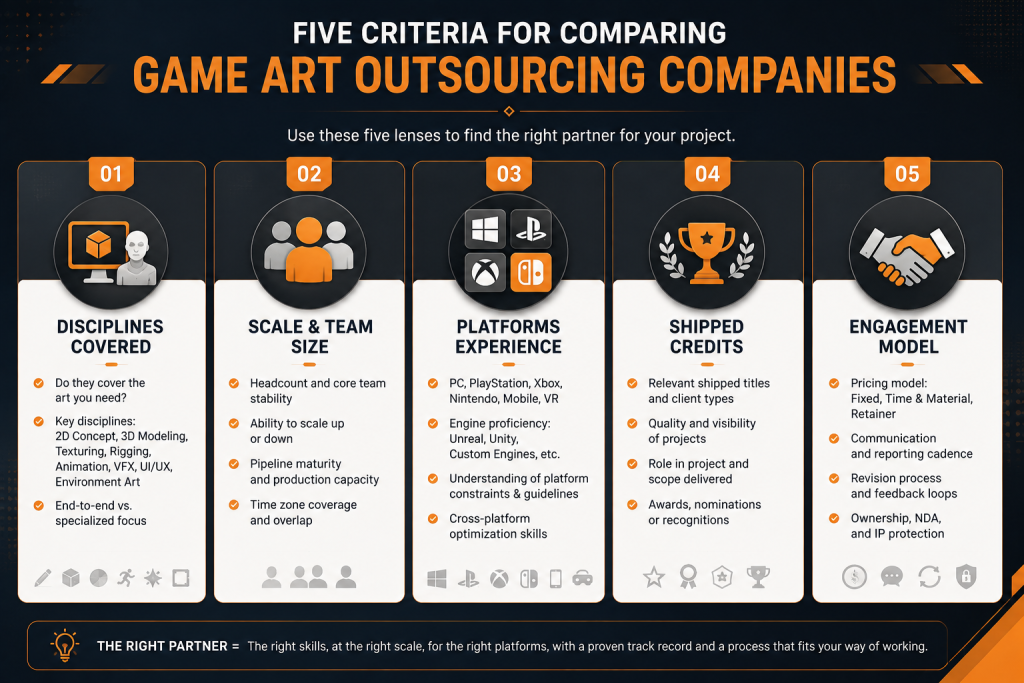
Five publicly observable variables give a useful first-pass distinction between vendors. None of them measures quality; all of them shape how an engagement will be structured.
“Editorial illustration created for visual reference purposes. It does not represent a real project, client work, or official software screenshot unless stated otherwise.”
Disciplines covered. A company doing concept art, 3D, animation, and UI is structurally different from one built around hard-surface 3D. Breadth can reduce the number of vendors you have to manage. Specialist depth matters most when a narrow asset class depends on established workflows and fewer technical corrections. Which of the two helps you depends on whether your bottleneck is coordination or a specific asset class.
Scale. A 4,000-person organization and an 80-person studio may well bid for the same scope, but they are likely to staff, structure, and prioritize it differently — in minimum engagement size, in how much surge capacity is available, and in how much your project weighs against everything else in their quarter. Note that headcount does not predict how directly you will communicate with the artists: a small studio may route everything through a founder, and a large one may assign a dedicated team with a named lead. Establish the actual communication structure from the proposal rather than inferring it from a number.
Platforms and engines. Unreal Engine 5 and Unity dominate, but the useful question is narrower: has this company delivered assets that passed performance profiling on your target platform, or has it delivered renders? Those are different competencies, and portfolios rarely distinguish between them.
Shipped-title credits. A credit shows that the company contributed work which reached a commercially released product. It does not, on its own, reveal the scope of that contribution, whether the vendor stayed through final integration, or whether its team took part in platform certification. Those are questions for a reference call. Of the five variables here, shipped credits are usually the easiest for a third party to verify independently.
Engagement model. Project-based work, ongoing capacity, and outstaffing distribute production risk very differently, and a mismatch here is often more consequential than any difference in artistic capability. We have written about how those cooperation models behave in production — the short version is that this is the variable teams most often get wrong.
Jurisdiction sits alongside these five and should be recorded separately, because it affects contracting, IP handling, and dispute resolution. The operational implications are covered in our guide to studio geography. The ten companies below span seven primary locations.
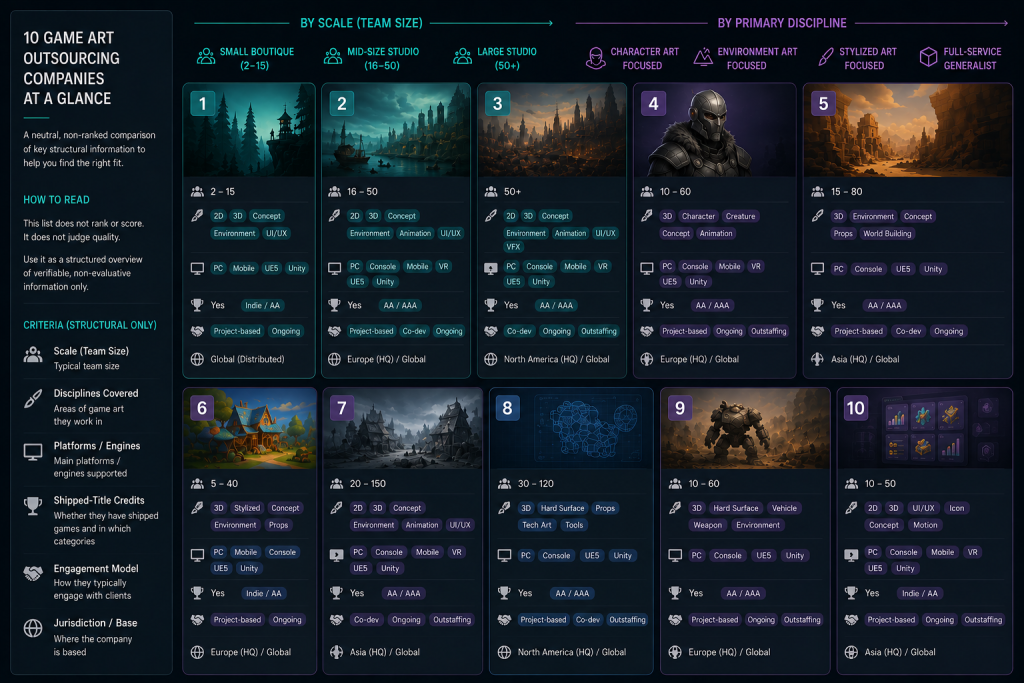
The ten companies at a glance
Alphabetical order. Figures are self-reported unless marked otherwise, and each is attributed to where it was found.
| Company | Primary base | Scale, as published | Art disciplines | Engagement models | Source, checked July 2026 |
| Argentics | Hollywood, Florida, USA | 80+ | 2D, 3D, UI/UX | Outsourcing, co-development | argentics.io/about-us; company databases for incorporation year |
| iLogos Game Studios | Gibraltar | ~300; ~460 projects | 2D, 3D, art production division | Full-cycle, co-production | ilogos.biz/who-we-are; linkedin.com/company/ilogos |
| Juego Studios | Bangalore, India (US entity in Plano, Texas) | 250+ specialists; 200+ shipped projects | 2D, 3D, concept, animation | Full-cycle, co-development, outstaffing | juegostudio.com/about |
| Kevuru Games | Kyiv, Ukraine | Not consistently published; third-party profiles give 200–350+ | 2D, 3D, animation, concept | Project-based, outstaffing | kevurugames.com/game-art and /about-company; B2B directory profiles |
| Lakshya Digital | Gurugram, India | 1,000+; 175+ AAA titles | 2D, 3D, animation, VFX | Art production, dual-shore | lakshyadigital.com and /about-us; linkedin.com/company/lakshya-digital |
| N-iX Game & VR Studio | Lviv, Ukraine | ~210–240 in the game unit; parent group ~2,200 | 2D, 3D, animation | Co-development, art production | linkedin.com/company/n-ix-game-vr-studio; third-party profiles for the unit figure |
| Nasty Rodent | Tallinn, Estonia | 40+ artists; 10+ years | 3D, concept art, UX/UI | Project-based, ongoing, outstaffing | nastyrodent.com and /services/ |
| Pingle Studio | Development offices in Ukraine; legal entity in Limassol, Cyprus | Not published as a current figure; company stated close to 400 in a 2023 industry interview, no newer total found | 2D, 3D, animation, concept | Art production, porting, co-dev | linkedin.com/company/pinglestudio; pocketgamer.biz company spotlight, 2023; Cyprus company registry, HE 385418 |
| Room 8 Studio | Limassol, Cyprus | 736; 992 titles; 573 partners | 2D, 3D, animation, VFX, cinematics | Art production, co-development | room8studio.com/company; company databases for base and founding year |
| Virtuos | Singapore | Latest consolidated claim 4,200+ across 26 offices, January 2025; ~7% of roles cut July 2025; no newer total found | 2D, 3D, animation, VFX | Co-development, art production | virtuosgames.com/news, announcements of January and July 2025 |
Sources are identified as precisely as the available public material allows. Where a company publishes a figure on a specific page, that page is named. Where a figure varies across company databases or third-party profiles — as it does for founding years and for two of the headcounts — the category of source is named instead, because no single page can be pointed to honestly. References appear as plain text rather than links, under an editorial policy that limits outbound links to a defined set of industry sources.

The ten companies
Every profile follows the same template and the same length discipline, including our own.
“Editorial illustration created for visual reference purposes. It does not represent a real project, client work, or official software screenshot unless stated otherwise.”
Argentics
Argentics states on its own site that it has been operating since 2017 and describes a team of 80-plus. Some company databases list 2018; because those entries may record the incorporation of a legal entity rather than the start of operations, the two dates are better read as different categories than as a contradiction. The registered base is Hollywood, Florida.
Services cover 2D and 3D art production, UI/UX, and end-to-end development in Unity and Unreal, with a branch into blockchain-adjacent work from 2021. The company does not publish a list of released titles it has contributed to — worth requesting directly if credits matter to your evaluation.
iLogos Game Studios
Operating since 2006 and headquartered in Gibraltar, iLogos states around 300 specialists and roughly 460 completed projects. The exact project count differs between the company’s own surfaces, which are not fully synchronized — one more reason to treat any single figure as approximate. The company organizes into divisions covering game development, art production, live operations, and porting.
It positions around full-cycle production and co-production rather than art alone, and its public client references skew toward free-to-play and mobile publishers. Two decades of continuous operation indicates business continuity; it says nothing on its own about the current production team or its fit for a particular brief.
Juego Studios
Juego Studios traces its start to 2013 and operates across India, the United States, the United Kingdom, and Saudi Arabia, with the parent company and global delivery organization in Bangalore and a US entity in Plano, Texas. Its About page states more than 250 specialists across art, engineering, design, and LiveOps, more than 200 shipped projects across genres, and ISO 9001:2015 certification.
The positioning combines art outsourcing with full-cycle and co-development capability. A multi-country footprint may support broader timezone coverage, though where the proposed production team actually sits, and which working hours overlap with yours, is something to confirm in the proposal rather than assume from an office list.
Kevuru Games
Kevuru Games works from Kyiv, Ukraine, with additional offices, and states 13 years in game art services and more than 100 shipped titles. Independent company profiles place the founding between 2011 and 2012 and the team anywhere from 200 to 350-plus, and the company does not publish a single consolidated headcount. That spread is a useful illustration of how soft this category of data is across the whole sector.
Publicly named clients on the company’s site include Epic Games, EA, and Lucasfilm. Services span 2D and 3D art, animation, and concept work, offered both as project-based engagements and as outstaffing.
Lakshya Digital
Founded in 2004 in Gurugram and acquired by Keywords Studios in 2014, Lakshya states more than 1,000 professionals and over 175 AAA titles delivered, with studios in Gurugram, Pune, Bengaluru, Manila, and Seattle. Named credits on its own channels include Elden Ring, Baldur’s Gate 3, and Alan Wake II.
Of every company here, this is the one whose record is most checkable against third-party sources, since credits at this volume appear in independent game databases. Keywords Studios was taken private in October 2024 and is no longer publicly listed, so group-level reporting obligations should not be assumed — confirm which governance, security, and reporting processes apply to the team assigned to your engagement.
N-iX Game & VR Studio
The studio began in 2012 as a separate unit inside N-iX, an international software development company its own channels describe as roughly 2,200 specialists. The game unit itself is described at approximately 210 to 240 people — the distinction matters, because the parent figure is not capacity available to a game project.
That parentage is the defining structural fact: engineering capability sits inside the same organization as art production. For work spanning both asset creation and technical development, that may remove a handoff between separate vendors — though how the two teams are managed internally is worth confirming rather than assuming. For an art-only engagement, the art team is one line of business among several.
Nasty Rodent
We are a game art studio registered as Nasty Rodent OÜ in Tallinn, Estonia, producing 3D characters, environments, props, vehicles, and weapons, plus concept art and UX/UI. Our site states more than ten years on the market and a team of 40-plus artists. As with every self-reported figure in this comparison, the number that decides your project is the capacity allocated to it, not a company total — ask us to put that in writing.
Shipped credits include Squad, developed by Offworld Industries, alongside Ready or Not. Both are tactical shooters, and much of our publicly visible hard-surface work is concentrated in that category.
Engagement models include project-based work, ongoing capacity, and outstaffing. Our weapon and vehicle work on those titles is documented on the Ready or Not project page.
Pingle Studio
Pingle describes itself as a Ukrainian company operating since 2007, with development offices in Kyiv, Lviv, and Dnipro, a legal office in Limassol, Cyprus, and representative facilities in London and Ottawa. The Cyprus entity appears in the national company registry. The company does not publish a current headcount; in a 2023 industry interview it put the team at close to 400, and we found no newer consolidated figure.
Alongside art production, its public materials centre on porting and co-development in Unity and Unreal — taking a shipped title onto additional platforms is a technical discipline distinct from asset creation. Named credits on its own channels include the PS VR2 port of Five Nights at Freddy’s: Help Wanted.
Room 8 Studio
Founded in 2011 and headquartered in Limassol, Cyprus, Room 8 Studio publishes 736 professionals, 992 titles it has helped ship, and 573 studio partners. It is part of the wider Room 8 Group and covers concept art, 2D and 3D, animation, VFX, and cinematics.
The company also states that it holds ISO 27001 certification for information security. Unlike the figures above, that class of claim is issued by an external certification body — but the certificate’s legal entity, scope, standard version, and expiry all vary, so a procurement team running a security review should request the current certificate rather than rely on the claim.
Virtuos
Founded in Shanghai in December 2004 and headquartered in Singapore, Virtuos stated more than 4,200 employees across 26 offices and over 1,500 titles delivered in its January 2025 announcements. In July 2025 the company said a restructuring affected approximately 7% of its global workforce, around 270 roles. We found no newer consolidated headcount in its public materials as of July 2026, so the January 2025 figure should be read as the last published total rather than a current one. Virtuos does not develop original titles of its own and works exclusively as an external partner, which is unusual at this scale.
Growth has come substantially through acquisition, and the acquired studios retain their own histories and pipelines. Buyers should ask which subsidiary, office, or production team would actually deliver the engagement.
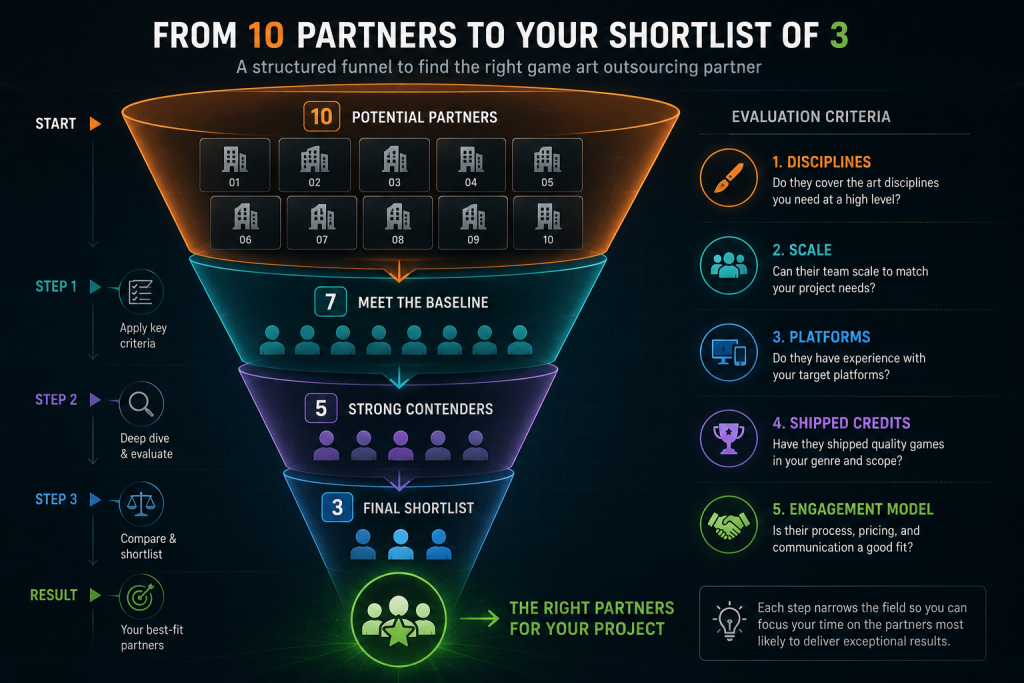
From ten companies to a shortlist of three
A list is not a decision. Three moves turn one into the other.
“Editorial illustration created for visual reference purposes. It does not represent a real project, client work, or official software screenshot unless stated otherwise.”
Cut on structure before you open a portfolio. Most buyers start by reacting to images, which inverts the process: portfolio quality is heavily curated and reveals less about delivery behaviour than references, a paid pilot, or a look at the proposed production team. Cut first on what cannot be curated — whether scale matches the capacity you need, whether the engagement model distributes risk the way you want, and whether the jurisdiction works for your legal team.
Then triangulate what you have been told. Self-reported claims can rarely be independently verified, but most can be cross-checked. Released-title credits can be checked against game databases and credits records. Incorporation date, legal entity, and certain ownership details appear in corporate registries, depending on jurisdiction. Visible professional-network profiles indicate the rough scale of a team without establishing an exact headcount. A focused desk-research pass surfaces most obvious discrepancies; private-company headcount and delivery performance will remain estimates whatever you do.
Only then look at the work, and look at it against your brief rather than in the abstract. The question is not whether a company produces good art. It is whether it has produced this class of asset, at this fidelity, for this platform. Five shipped tactical weapons tells you more about a tactical shooter brief than fifty stylized fantasy pieces.
Ask the remaining candidates the same questions in writing. The structure that makes proposals genuinely comparable, and the difference between the document that selects a vendor and the one that governs the work afterwards, is covered in our guide to writing an RFP and an SOW for game art.
One decision sits upstream of all of this. If you have not settled whether you need a studio at all, versus individual artists or an internal hire, a shortlist is premature — the comparison resolves differently depending on whether your constraint is capacity, specialization, or headcount policy.
What this list will not tell you
Every roundup in this category, ours included, has the same blind spots. Naming them is more useful than pretending they are not there.
It cannot tell you about delivery or team fit. Nothing above reflects what happens at milestone three, when the brief has drifted and the schedule is tight, or whether a company’s review rhythm matches your milestone calendar. Both are established only through comparable references and a paid pilot run against the real brief — and a vendor that cannot produce two references from projects of similar scope is telling you something.
It is a sample, not a market map. Ten companies out of several hundred that meet the criteria. Absence from this list means nothing except that a list has ten places.
It ages. Headcount, ownership, and capability change quarterly here. Everything was checked in July 2026. If you are reading this later, the structural observations will hold up better than any specific number.
The most useful thing you can do with a list like this is treat it as a starting set of names and a set of questions, then check independently. Our own work is in the portfolio precisely so it can be checked the same way we are suggesting you check everyone else’s.
After you choose
Selection is only the first risk gate. The chosen vendor still needs documentation transfer, pipeline access, a calibrated first batch, named review owners, and measurable acceptance criteria — and the gap between signing and the first delivery is where a significant share of avoidable rework and production friction tends to appear. We cover that phase separately in our eight-week vendor onboarding protocol.
If you are at the shortlist stage and want a second opinion on scope, technical requirements, or whether your brief is specific enough to compare proposals fairly, that conversation is worth having before you send an RFP. Our service overview sets out what we cover across 3D, concept art, and UX/UI, and we will tell you plainly if your project is a poor fit for us.