Concept Art vs. Illustration: What Actually Separates Them in Games
-

Written byDenys Zadoienyi
-

Updated on25.09.2026
-

Time to read13 min

- Why Studios Keep Mixing These Up – and What It Costs
- Concept Art vs Illustration: The Core Functional Difference
- Why Key Art Can Look Like Concept Art Without Serving the Same Job
- Concept Art vs Illustration by Asset Type
- What This Means When You’re Briefing or Outsourcing
- Concept Art vs Illustration: Side-by-Side
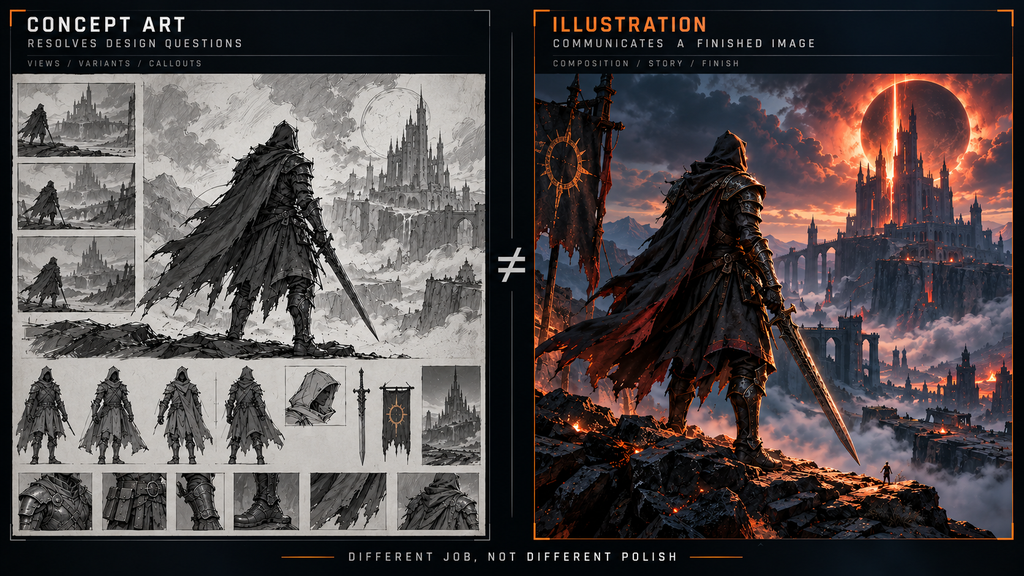
“Editorial illustration created for visual reference purposes. It does not represent a real project, client work, or official software screenshot unless stated otherwise.”
Concept art vs illustration is a distinction that sounds academic until it shows up in a vendor contract, and by then it is usually too late to fix cheaply. A studio briefs “character illustrations” when it needs a turnaround sheet a 3D team can build from, receives a beautiful single-angle painting on schedule, and only discovers the gap when modeling starts asking questions the concept phase was supposed to answer. The image was not wrong. The word was.
Concept art primarily exists to explore, resolve, or communicate design decisions for production. Illustration primarily exists to communicate a finished visual idea to its intended audience. The boundary is functional rather than stylistic, and individual deliverables can overlap – a highly polished mood painting made during exploration is still concept art, and a rough promotional sketch rushed out for a marketing deadline is still illustration. In game production, confusing the two produces the wrong scope, the wrong review criteria, and the wrong deliverable.
Why Studios Keep Mixing These Up – and What It Costs
The confusion is not a vocabulary problem. It is a scoping problem that hides inside a word both disciplines share: “art.”
A producer who needs a hero character specified for 3D modeling and a producer who needs a finished piece for a Kickstarter page or a store listing are asking for structurally different things, but both requests can arrive on a vendor’s desk as “character art.” When the brief does not distinguish them, one of two failure modes shows up:
- Production time spent polishing an image before the underlying design questions are resolved. A studio commissions a fully rendered image at the concept stage and still has to answer the questions the piece never addressed – what does the back look like, what materials is this made of, does the silhouette meet the readability requirements defined for the game.
- A finished illustration treated as a production spec. The opposite failure: a striking three-quarter illustration gets handed to a 3D team as if it were a concept package. The modeler fills every gap the image does not answer, and each guess becomes a revision request once the art director reviews the built asset against an intent that was never actually specified.
Both failures trace back to the same root cause: the brief asked for “art” instead of asking for a function. Understanding what each discipline is built to do is the fix.
For readers who want the full picture of concept art’s role across an entire production cycle – not just its distinction from illustration – our earlier piece on what concept art actually does in production covers the definition, the six production types, and the pipeline stages in depth. This article stays narrower: it isolates the one distinction that causes the most expensive scoping mistakes.
Concept Art vs Illustration: The Core Functional Difference
Concept art explores, resolves, or communicates a design decision for a production team. Illustration communicates a finished visual idea to the audience it was made for. That single distinction explains most of what separates them – though it is a heuristic for reading a brief correctly, not a rigid taxonomy with no exceptions.
Concept art is aimed at art direction and downstream production disciplines. Its quality is measured by how completely it lets a 3D artist, an art director, or a UI developer act on it without guessing – though not every concept deliverable is a literal build specification. Early exploration work can establish mood, lighting direction, or overall visual language before any single asset is locked, and that work is still concept art because it is resolving a production question, not delivering a finished audience-facing piece. It is produced expecting revision, because the questions it answers often change as a design is tested against the rest of a project.
Illustration is usually a finished visual communication deliverable rather than a specification another discipline must reproduce. Its quality is measured by composition, emotional impact, and polish – the qualities that make an image work as a complete statement rather than as one input into someone else’s production process. A key art poster, a loading screen, a store page hero image, and a marketing illustration all belong to this category. That does not mean an illustration engagement always produces a single file: a finished illustration deliverable can include a master artwork plus platform crops, aspect-ratio variants, or localized versions – what defines it is that none of those variants exist to be rebuilt into a different asset.
Neither discipline is a lesser or rougher version of the other. A concept sheet can be rendered to a high finish when the project needs it to communicate lighting or material quality precisely. A promotional illustration can be produced fast and loose when the deadline is tight. The defining line is not how polished the image looks – it is whether the image exists to resolve a production question or to stand on its own as a finished communication.
| Dimension | Concept Art | Illustration |
| Primary job | Explore, resolve, or communicate design decisions | Communicate a finished visual idea |
| Primary audience | Production stakeholders and downstream disciplines | Players, publishers, marketing audiences, or other intended viewers |
| Typical review focus | Design logic, clarity, consistency, downstream usability | Composition, storytelling, readability, finish |
| Iteration | Often exploratory before design lock | Usually converges toward an approved final image |
| “Done” depends on | The production question being resolved to the required level | The image meeting its intended communication and delivery requirements |

Why Key Art Can Look Like Concept Art Without Serving the Same Job
The distinction gets genuinely blurry in two places, and pretending it does not exist creates its own set of scoping problems.
Key art is a useful boundary case. It may use the same artists, the same tools, and the same visual-development language as concept art – often the same characters and environments a concept phase already designed – while serving a different primary purpose: presentation and promotion. It is often produced after core visual direction is established, although pitch and announcement work can appear earlier in development. Key art does not need a turnaround sheet or material callouts, because its primary job is not to serve as a production specification for another game asset; it needs to sell the game. Briefing key art as if it were concept work wastes iteration on views nobody will ever use; briefing it as if it were a casual illustration underspecifies the visual consistency it has to maintain with an already-approved design.
Portfolio pieces cause a related confusion, in the other direction. A polished, standalone portfolio image may show only the most presentation-ready part of a much larger production package – the hero angle, not the turnaround sheet, the callouts, the variants, or the handoff materials that actually shipped with it. Evaluating a vendor from that image alone does not tell you which of those production elements were included in the original scope. Our breakdown of the AAA character concept pipeline makes a related point directly: judging character concept art as “is it a good drawing” is exactly the wrong test for a production pipeline, because a good drawing and a buildable specification are not the same deliverable.
Recognizing key art and portfolio pieces as boundary cases – rather than as evidence that “concept art and illustration are basically the same thing” – keeps a brief precise even when a project genuinely needs both disciplines from the same vendor.
Concept Art vs Illustration by Asset Type
The functional split plays out differently depending on what is being designed, and studios that brief by asset type get cleaner results than studios that brief by a single blanket instruction.
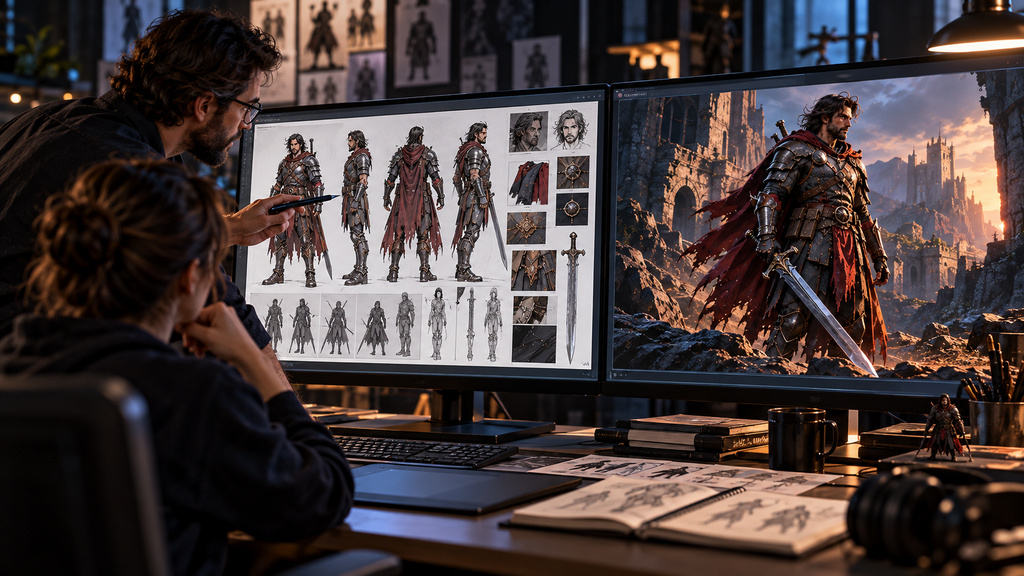
Characters. Character concept art often has to answer production questions that a finished illustration is not required to resolve: what does the costume look like from the back, which straps are functional versus decorative, how does the silhouette read against the rest of the cast. A finished character illustration may communicate some of the same information, but it is not normally responsible for documenting every production-relevant view or construction detail – it shows the character once, from the angle that looks best, in the pose that tells the story. On Wild Rage, developed for Whimsy Games, Nasty Rodent led overall art direction across concept art, character design, weapons, props, environments, and UI/UX for a stylized MMORPG – a useful example of concept work operating inside a wider production system rather than as an isolated image deliverable.
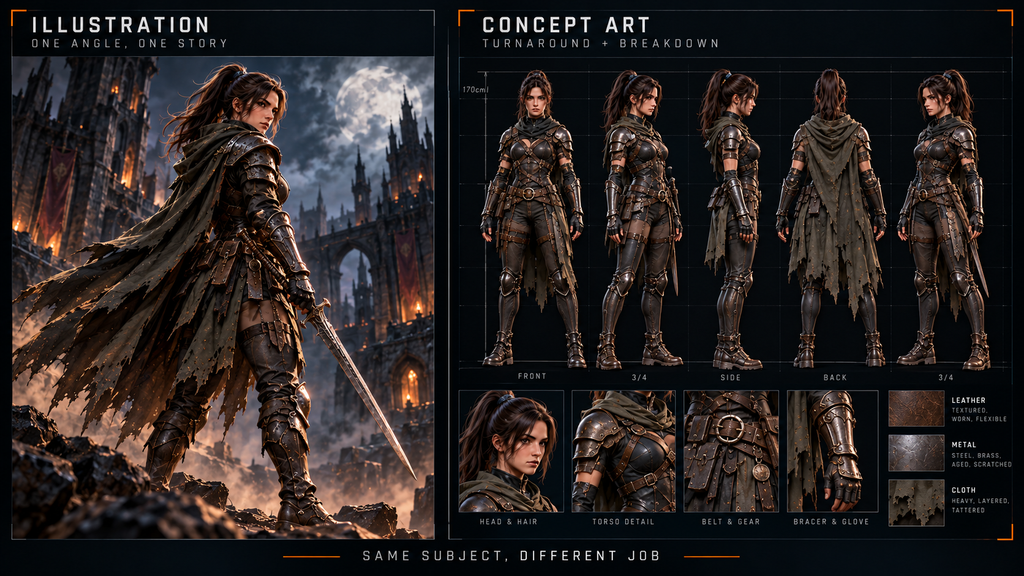
“Editorial illustration created for visual reference purposes. It does not represent a real project, client work, or official software screenshot unless stated otherwise.”
Weapons and props with visual variants. Weapon skin concepts are a narrower slice of concept work: a base weapon already exists, and the brief is to design cosmetic variants – a new material finish, a themed paint job, an event-specific look – that a 3D artist can then apply to the existing model. This is concept art in function even though the base geometry is already locked, because the deliverable still has to specify a material and color direction precisely enough to be modeled and textured. On Squad, developed by Offworld Industries, Nasty Rodent’s documented scope covers concept art, unique skins, and final vehicle and weapon assets – a clear, publicly documented example of concept work feeding directly into downstream production.
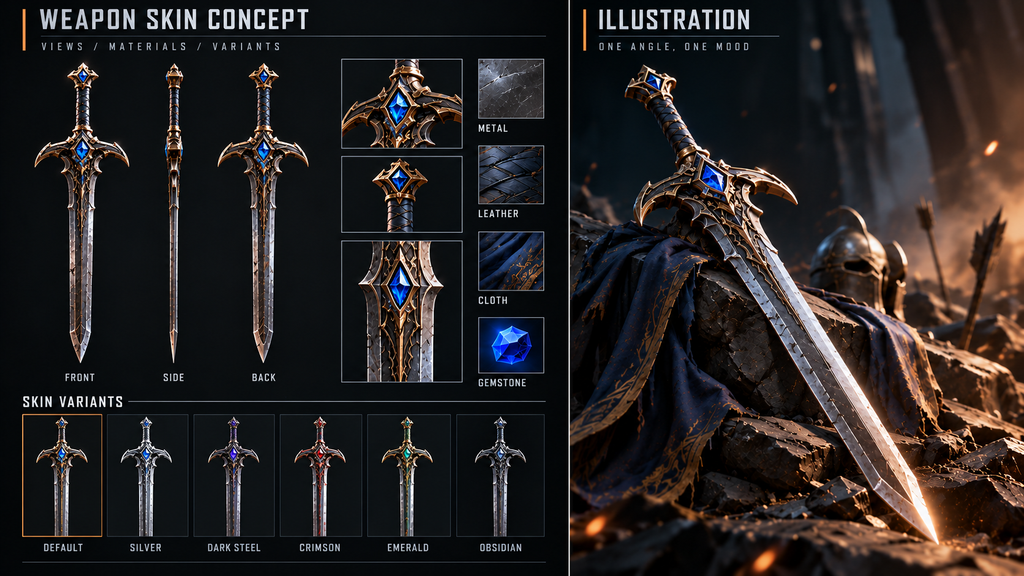
“Editorial illustration created for visual reference purposes. It does not represent a real project, client work, or official software screenshot unless stated otherwise.”
Casual and mobile production. Stylized, casual-facing projects often compress concept and illustration closer together than realistic AAA titles do, because the finished in-game art is closer in polish to a concept sketch from the outset. Bubble Quest of Vikings, developed by Whaleapp, is the clearer production example here: concept design, character creation, environments, UI, and visual effects were all part of one broader art-production engagement, which is exactly the kind of case where the concept-versus-illustration line matters – a single visual system had to hold across every one of those disciplines. Wave Master, developed by Banner Games, is a related but narrower example: it was a UI-focused engagement covering UX/UI design and supporting graphic assets, with the interface as a central part of the scope. The published case does not document environment or prop concept work in the same detail, so this article does not extend Wave Master’s scope beyond what is publicly documented.
The pattern across these cases is consistent: the deliverable behaves as concept art whenever something downstream still depends on the information in it, regardless of how finished the image itself looks.
What This Means When You’re Briefing or Outsourcing
The concept-versus-illustration distinction is not academic once it reaches a real brief or a vendor conversation – it changes what you ask for and what you should expect back.
“Editorial illustration created for visual reference purposes. It does not represent a real project, client work, or official software screenshot unless stated otherwise.”
In a brief, the deliverable specification has to name the function, not just the subject. “A character illustration” and “a character concept with front, side, and back views and a material callout sheet” describe the same creative subject but entirely different scopes of work, timelines, and prices. Our production guide to writing a concept art brief covers this in detail, but the short version is worth repeating here: concept art is not illustration commissioned for its own sake, and a brief that treats it that way generates a deliverable that has to be re-scoped after the fact.
In an outsourcing conversation, the distinction affects contract shape as much as it affects the art itself. Concept work usually expects iterative review before a design lock point; illustration review is organized around approval of a final visual deliverable. The exact number of revision rounds belongs in the statement of work rather than in a universal rule, since it depends on asset complexity, feedback structure, and how the engagement itself is scoped. Our guide to how concept art engagements change by production stage breaks down how scope, approval authority, and contract shape shift depending on where a project sits – and the same logic applies before signing anything: know which discipline you are buying before you negotiate how it is priced.
Getting this right at the brief stage is cheaper than correcting it after delivery. A studio that specifies the function it needs – a design specification versus a finished communication piece – gets a first-pass result that matches the pipeline it was meant to serve.
Concept Art vs Illustration: Side-by-Side
| Aspect | Concept Art | Illustration |
| Purpose | Explore, resolve, or communicate design decisions | Communicate a finished visual idea |
| Audience | Production stakeholders and downstream disciplines | Players, publishers, marketing audiences, or other intended viewers |
| Review focus | Design logic, clarity, consistency, downstream usability | Composition, storytelling, readability, finish, delivery requirements |
| Iteration | Often exploratory before design lock; scope defined in the SOW | Usually converges toward an approved final deliverable |
| Typical outputs | Thumbnails, variants, design sheets, callouts, turnaround views | Key art, promotional illustration, splash art, narrative or editorial imagery |
| “Done” depends on | The production question being resolved to the required level | The image meeting its intended communication and delivery requirements |
A useful first question when scoping a brief is: does another production decision or asset depend on the information in this image, or is the image itself the primary deliverable? It is not a universal taxonomy rule – exploratory mood art and pitch visuals complicate any clean split – but it usually exposes what the brief actually needs.
Production concept workflows increasingly mix 2D and 3D tools when doing so reduces ambiguity between design and downstream asset production. In a 2019 piece for ArtStation Magazine covering the shift toward 3D-assisted concept workflows, the publication describes how concept artists producing 3D reference alongside 2D paintings shrink the interpretation gap between concept and the team building from it. A separate production breakdown published on 80.lv, describing how concept artists move between exploratory and problem-solving phases on the same project, makes the related point that both phases are still concept art, doing a job illustration was never meant to do.
If your project needs both concept art and finished illustration – a common combination once a game approaches its marketing phase – Nasty Rodent’s concept art services cover characters, environments, props, vehicles, weapons, and UI concepting across realistic and stylized styles, scoped against whichever pipeline stage the work actually feeds.
Studios that get this distinction right at the brief stage do not eliminate revisions – concept art is supposed to iterate. What they eliminate is the far more expensive kind of rework: discovering three weeks into modeling that the “concept” everyone approved was never built to answer the question a 3D artist is now asking.