How AAA Teams Work With an External Props Studio
-

Written byDenys Zadoienyi
-

Updated on02.11.2026
-

Time to read17 min

- Why a Prop Library Needs Its Own Operating Model
- Who Decides What: A Decision Map for Both Studios
- Setting Review Priorities for Different Kinds of Props
- What Goes Out in a Review Packet and What Comes Back
- Where the Trap Is: Visual Approval Is Not Acceptance
- A Handoff the Level Team Can Use
- What Changes Across Milestones and Titles
- Our Approach
- Three Ways to Plug a Props Partner Into Your Team
- Planning an External Props Batch?
When a large team brings in an external props studio, a props batch can meet its visual target and still stall at handoff if the two teams have not agreed who decides, what each review approves and who owns integration. For a producer, the job is to keep those decisions connected while the asset list keeps growing.
“Editorial illustration created for visual reference purposes. It does not represent a real project, client work, or official software screenshot unless stated otherwise.”
A collaboration model with an external props studio defines responsibilities, review decisions, acceptance criteria and handoff steps between the client and the partner. For a props library, it also identifies who maintains the agreed conventions and who records changes to them, so new work follows the same rules as the work already in the build.
Why a Prop Library Needs Its Own Operating Model
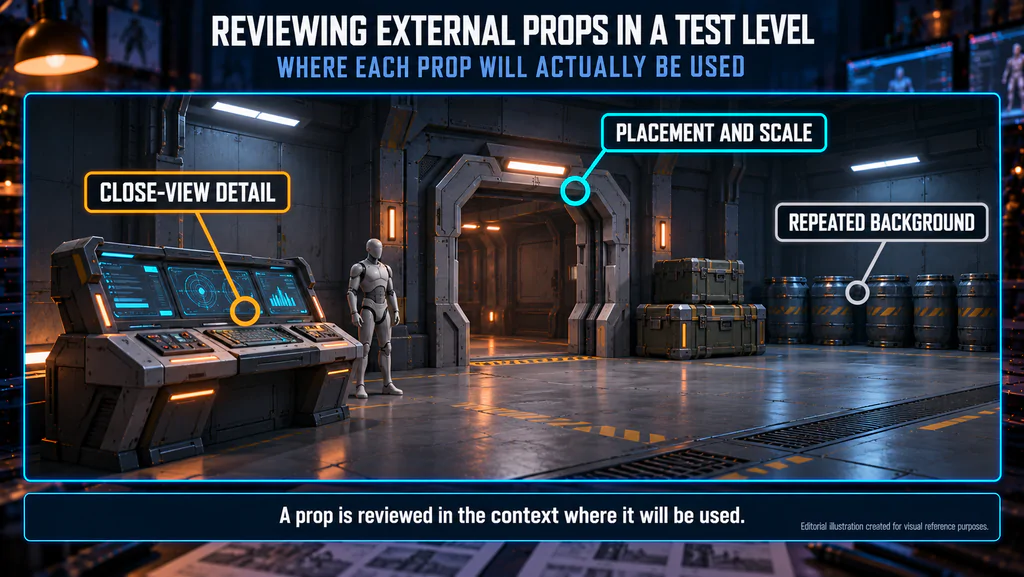
A props library may combine close-view hero assets, interactive objects, set dressing and repeated background content. These groups can share materials, placement rules and technical dependencies while needing very different kinds of review. A crate in the background and a console the player operates are both “props”, but they may need different reviewers and different evidence, depending on their intended use and the agreed requirements.
On the client side, several functions usually contribute to a single prop decision: visual direction, environment art, technical art and level design. Each has a legitimate interest. The art director looks at material response and wear. The environment lead looks at how props sit together in a scene. The technical owner looks at budgets, collision and pivots. The level designer looks at scale, readability and where a prop can go. Direct specialist discussion between the two studios is useful, but conflicting instructions have to be resolved on the client side before they become the partner’s production brief.
Without that coordination, problems compound in a familiar order. Notes arrive in parallel and the partner cannot tell which one governs. A prop passes a visual review while a gameplay or integration question is still open. When the dressing pass begins, part of the delivered library needs another round, and capacity planned for new content goes into resolving questions that could have been settled earlier.
None of this requires a heavier process. It requires a few explicit agreements. The sections below connect them in order: decision ownership, review priorities, actionable submissions, the difference between visual approval and acceptance, and a handoff the receiving team can use.
Who Decides What: A Decision Map for Both Studios
“Editorial illustration created for visual reference purposes. It does not represent a real project, client work, or official software screenshot unless stated otherwise.”
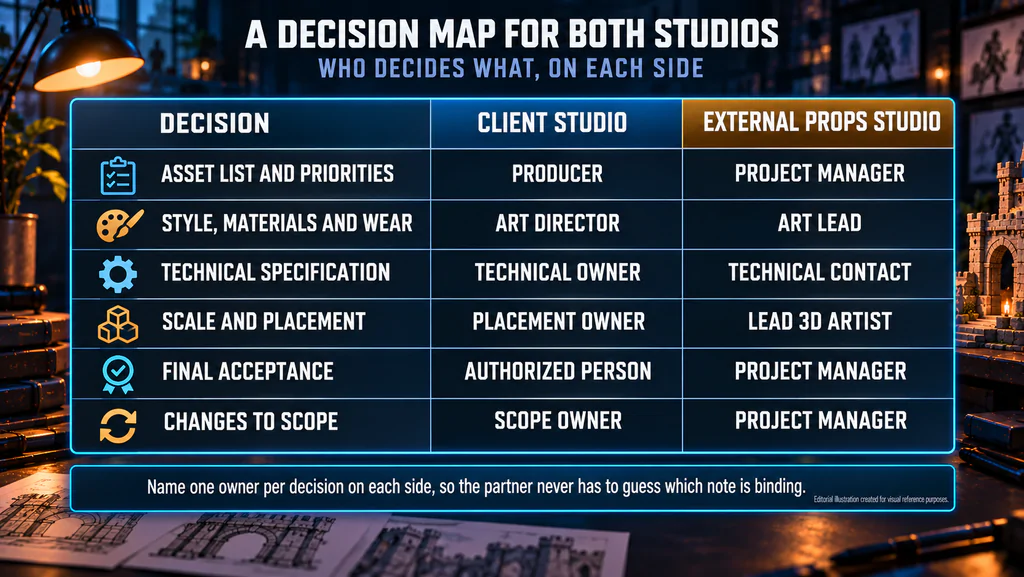
Start by agreeing, before the first batch, which decisions belong to which function on each side. The point is not paperwork. It is that the partner does not have to guess which note is binding, and your own team knows who resolves a disagreement.
A named point of contact helps keep decisions coordinated, and our guide on how to brief an external art studio covers that rule together with the brief behind it. A props engagement adds a second half: one voice for decisions does not have to mean one channel for work. Technical questions about collision or pivots often move faster between the designated technical contacts on both sides, as long as the resulting decision is recorded by the person who owns it.
The following is one possible allocation for a props engagement. Map these functions to named people on both sides; job titles and approval authority vary by studio and by agreement, and one consolidated decision can still require input from several specialists.
| Decision | Decision owner (client) | Partner delivery owner | Consulted | Risk if nobody owns it |
| Asset list and priorities | Producer | Project manager | Environment lead, level design | Work proceeds in an order that does not match milestone dependencies |
| Style, materials and wear language | Art director | Partner art or discipline lead | Environment lead | Small differences accumulate until the set no longer reads as one game |
| Technical specification: budgets, collision, pivots, naming | Designated technical owner | Partner technical or discipline contact | Engine or tools programmer | Props pass visual review and fail on import |
| Scale and placement rules | Designated gameplay or placement owner | Lead 3D artist | Art director | A prop looks right on its own and wrong next to a door frame |
| Final acceptance of a delivery | Person authorized under the agreement, informed by the required reviewers | Project manager | Required visual, technical and production reviewers | Each side assumes the other has accepted the batch |
| Changes to scope or specification | Authorized scope owner, coordinated by the producer | Project manager | Owner of the affected area | Change requests arrive disguised as feedback and quietly move the schedule |
Keep the map short enough to use. If responsibilities overlap, name who resolves the disagreement and who records the decision returned to the partner. Our own published terms ask the client to designate a point of contact with authority to approve deliverables and decisions, which is the same idea seen from the partner’s side.
Reporting on Carey Chico’s GDC 2009 talk, Game Developer described feedback routed through an art lead or a prioritized review process and written in a consistent voice, with reviews turned around quickly. That historical example supports the principle of clear, coordinated feedback; each engagement still needs its own review commitments.
The cost of a missing decision is easier to manage once you see where it lands. A delayed answer can hold up dependent work or leave the partner building against an unconfirmed assumption. Identify which assets depend on the open question and which can continue independently; a shared material or kit does not automatically mean every asset in it is blocked. For the art director, the cost appears in a different form: a set loses its consistency through small exceptions that nobody remembers approving.
Did you know?
External partners on major titles are not a recent trend. At GDC 2006, Microsoft Game Studios and Dhruva Interactive presented a case study of outsourcing on Forza Motorsport, covering good and bad practices across content production.
Setting Review Priorities for Different Kinds of Props
“Editorial illustration created for visual reference purposes. It does not represent a real project, client work, or official software screenshot unless stated otherwise.”
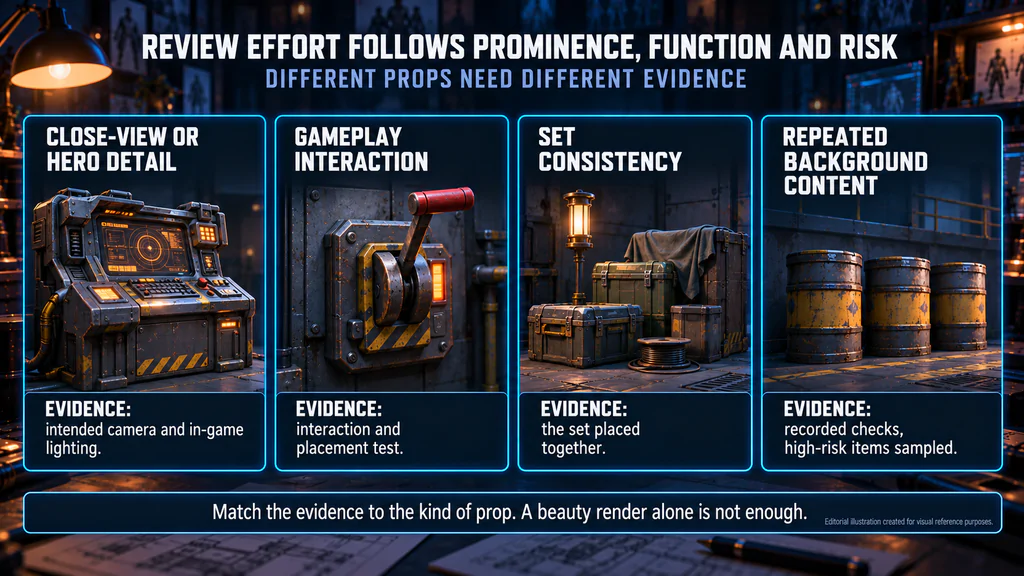
Review effort should follow visual prominence, gameplay function, technical risk and reuse. These dimensions overlap: a hero prop can also be interactive, and background clutter can be repeated widely enough to matter for performance. The production stages and budgets for different prop classes are covered in our 3D props production pipeline guide. Here, the same thinking helps decide who looks at what, in which context and with which evidence. The table is a starting point for allocating attention; it does not remove any checks required by the asset specification.
| Review focus | Reviewers to involve | Useful review unit | Evidence to request | Risk to avoid |
| Close-view or hero detail | Visual lead plus relevant technical reviewers | Individual asset, with related set context | Intended camera, viewing distance, approved references and in-game lighting | A beauty render used as the only approval evidence |
| Gameplay interaction | Relevant visual, design and technical owners | Asset or group sharing the interaction | Agreed interaction or placement test, with collision and pivot checks | Visual approval treated as functional validation |
| Set consistency | Environment or visual lead plus applicable technical reviewers | Themed set in a representative placed context | Comparison with approved neighboring assets and shared materials | Isolated approval that hides inconsistencies across the set |
| Repeated background content | Technical and visual owners under an agreed validation plan | Batch, with additional checks for high-risk items | Recorded conformance checks and appropriate in-engine context | Sampling treated as proof that every asset and placement was tested |
Two habits make this work. The first is a representative first batch. Use it to check the visual target, the applicable technical requirements and the review process itself before production expands. When we take over an existing prop backlog, our published approach starts with exactly that: a calibration batch checked against the client’s existing assets and conventions, with throughput increasing only after it is approved. On a new IP with no props in the build yet, the baseline is the approved references and benchmark assets instead.
The second habit is reviewing related props together wherever set consistency matters. A container that looks right on its own can carry slightly heavier wear than the rest of the room, and that only becomes visible when the props are seen side by side in the same lighting.
If you are an art director, this is also how you protect your own time. Reserve senior review for the decisions that need it, while keeping the required visual and technical checks in place for every relevant asset. Where sampling is agreed for repeated background content, record what the sample covered and escalate recurring issues or high-risk uses, so a sampling decision never turns into an untested assumption.
What Goes Out in a Review Packet and What Comes Back
Reviews become hard to act on when a submission cannot be judged against its baseline, or when a reply does not say what happens next. A compact template for both directions helps address these gaps, and it can be agreed with any props partner before the first batch. The evidence should match the checkpoint: an early shape review needs less than a technical handoff.

| Direction | What to include | What it establishes |
| Partner to client | Asset or batch ID, exact revision and links to the reviewed files | Which work is under review |
| Partner to client | Checkpoint, requested decision and the applicable brief, specification and reference version | What the reviewer is being asked to approve |
| Partner to client | Relevant views, reference comparisons and in-engine context where required | Evidence appropriate to the visual decision |
| Partner to client | Applicable technical results and the test configuration | What was checked, with what result and within what limits |
| Partner to client | Changes against previous notes, open issues and unresolved questions | What changed and what is still blocked |
| Client to partner | One consolidated decision per asset and checkpoint, tied to the submission | Approve for this gate, revise against named notes, or hold |
| Client to partner | The requirement or reference behind each note, the action owner and the next review date | What action is needed and who decides next |
An early shape review does not need final performance evidence. A technical handoff needs the relevant files and checks, not only images. Visual judgments still matter; anchor them to the approved target and the intended use, so “feels off” becomes “the wear is heavier than on the approved reference set”.
The hold status deserves its own sentence: without it, every item has to be forced into approve or revise. Hold means the affected work should not proceed until a named decision or dependency is resolved. Record the blocker, its owner and the expected decision point, and identify which other work can continue independently under the agreed plan. A hold can originate on either side: a pending decision from the client, or an open technical question raised by the partner.
For the art director, the consolidated reply is where conflicting notes get reconciled before they reach the partner. It takes discipline on the client side, but it turns a batch of separate opinions into a single decision the partner can act on.
Where the Trap Is: Visual Approval Is Not Acceptance
“Editorial illustration created for visual reference purposes. It does not represent a real project, client work, or official software screenshot unless stated otherwise.”
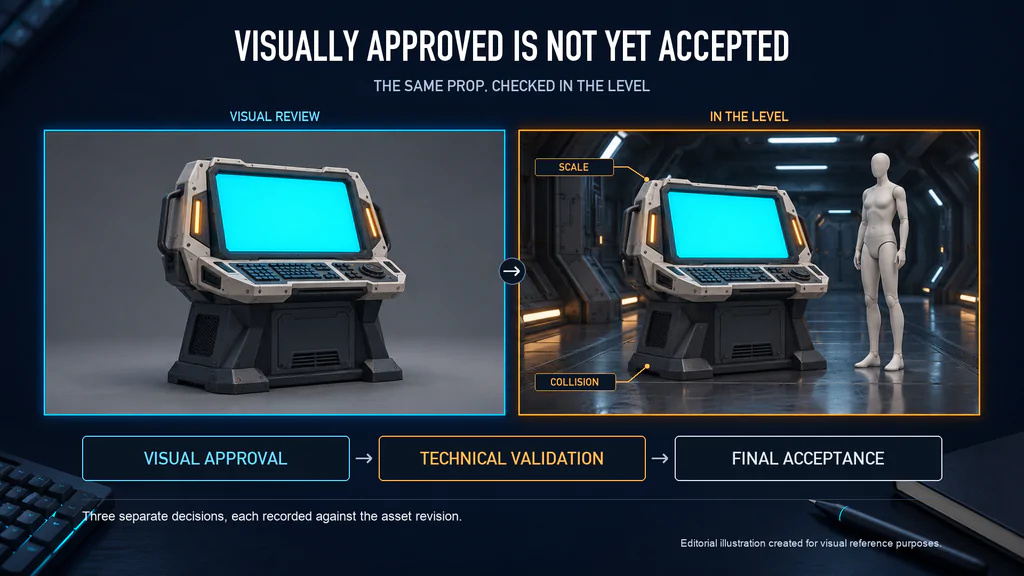
A visual review can pass while integration questions remain unresolved. A prop may match the approved presentation and still reveal a scale, collision or readability issue when it is tested in the agreed gameplay context. This is where the gap between “looks right” and “works in the game” becomes expensive, especially when a dressing pass is scheduled close to a milestone review.
The practical answer is to separate three decisions instead of treating approval as one event:
- Visual approval at the relevant review gate, against the approved target.
- Technical validation in the agreed engine configuration, against the specification.
- Final acceptance by the person authorized under the project agreement.
Record the asset revision and the result of each required check. A prop is ready for final acceptance when the agreed checks have passed and outstanding issues have been resolved or explicitly accepted where the agreement permits exceptions. A review deadline sets the time for a decision; silence does not replace that decision. Our own published terms state the same principle: silence or lack of response is not approval unless explicitly agreed in writing, and work is considered accepted once written final approval is given. The gate sequence underneath these decisions is covered in our guide to quality control for outsourced game art.
When an issue does appear after import, compare it with the requirement and the revision that applied at submission before deciding what it is. The following categories help route the investigation; a return can have more than one contributor, and its cause may still be unresolved when work has to continue.
| What the record supports | Classification to investigate | Next action |
| Submitted files miss a clear, applicable requirement | Delivery defect | Identify the failing revision and requirement; assign the correction under the agreement |
| Inputs were missing, ambiguous or contradictory | Input or specification gap | Clarify the baseline, record its effective version and assess the affected work |
| An approved requirement or intended use changed | Change to scope or direction | Assess the impact and agree the next work and its commercial treatment |
| Conflicting notes or another process failure caused extra work | Process contribution | Identify the process owner and correct the coordination problem |
| The request is planned creative refinement within scope | In-scope iteration | Handle it within the agreed review and revision arrangement |
| Evidence is incomplete or several contributors overlap | Undetermined or mixed contribution | Record a provisional attribution and keep resolving verified blockers |
A defect, a refinement and a change request are not interchangeable, and the classification alone does not settle who performs or pays for the work; the agreement does. If the delivered asset matches the reviewed revision, check whether the issue arose during import, configuration or placement before assigning it to the partner. Recorded this way, returns become a useful signal about the collaboration rather than a source of argument, and our guide to art rework rate explains how to read them without blaming the wrong side.
For a producer, the consequence is concrete. Unresolved integration work can delay the planned use of assets and consume capacity needed for the next batch. Catching it at the validation step, rather than during the dressing pass, keeps that capacity available for new content.
A Handoff the Level Team Can Use
Agree who receives each batch, who carries out the required validation and who has authority to accept it. Opening the files and placing representative props in a level provide evidence for that decision; they do not constitute acceptance on their own.
Which files a delivery should contain is covered in detail in our guide to the source files and handover package. On top of the package itself, use a short closeout record for each batch:
- reconcile the delivered inventory and revisions with the agreed asset list, including shared resources and documented exclusions;
- record visual approval and the applicable technical results in the agreed engine configuration;
- confirm access to the agreed sources, exports, engine content and dependencies, and identify who owns integration;
- list outstanding issues, untested areas and any explicitly accepted exceptions, each with a named owner;
- record the authorized acceptance outcome for this delivery revision.
A prop library also benefits from a note written for the level team rather than for artists. A practical handoff note covers:
- the intended uses of each prop and any agreed placement or reuse restrictions;
- shared materials and other dependencies, including which changes to shared resources may affect other assets;
- known limitations, with their resolution or explicitly recorded status;
- any held or excluded assets, the pending decision and its owner, clearly separated from accepted scope.
A concise handoff note gives the receiving team a record of the decisions and limitations that matter for placement and integration, so they do not have to reconstruct them from review threads weeks later.
Be explicit about the boundary of responsibility. Some teams want their partner to import and set up props in the engine; others keep integration in-house and only need files that import cleanly. Either works. What does not work is leaving it unstated, because the first batch then sits between the two teams with each side assuming the other owns the next step. “Engine-ready” should mean conformance to the agreed engine configuration and scope, not a promise that the receiving team will have no work to do.
What Changes Across Milestones and Titles
Continuing work benefits from a maintained record of approved conventions and decisions. Prop demand rarely arrives once: levels are added, live content needs new sets, and a following project may reuse part of what was agreed before. When a new milestone or title begins, confirm which rules still apply and which need to change. Earlier documentation can be reused only where it is relevant and access is authorized.
Keep that record in the project’s agreed documentation system, with a named owner and an approval process for changes. It can be part of the technical specification, the art bible or a linked decision log; a separate file is useful only if it avoids duplication. Whatever its form, it should hold:
- naming, pivot and folder conventions, with examples from approved props;
- the agreed visual tiers, gameplay requirements and technical criteria;
- the approved reference set for each tier;
- a log of review decisions with the date, effective version, affected assets and the authorized owner;
- the specification gaps found after import and how the specification changed.
A decision log preserves the reasoning behind approved conventions. For example, if a material treatment is restricted on background props, record the reason and the approved alternative, so a new artist on either side can apply the decision without reopening it.
Nasty Rodent’s work with The Bearded Ladies spans several released titles:
- Our documented contribution to Mutant Year Zero: Road to Eden includes weapons, props and environment assets.
- We delivered the same asset categories for Miasma Chronicles, published by 505 Games.
- For Corruption 2029, the case describes realistic vehicles and weapons.
Repeat collaboration with one developer is the situation a maintained record is designed for. Any carryover to another title should be agreed for that project and checked against the applicable ownership, licensing and confidentiality requirements.
Our Approach
Our 3D props outsourcing work addresses these coordination requirements with one production team behind the whole set. The art director reviews the set against itself, the project manager tracks each prop by tier and status, the lead 3D artist sets the quality bar for each tier, and the technical artist owns the constraints and the in-engine check before hand-off. We organize the work around the agreed visual direction and the receiving team’s conventions.
Three Ways to Plug a Props Partner Into Your Team
| Model | Who directs the work day to day | Who reviews | Who keeps the conventions | Fits best when |
| Project-based | Partner, against the approved scope and milestones | Client owners, per batch | Client approves the baseline; partner follows it and records agreed changes | A fixed scope with defined deliverables, such as a launch build or a DLC area |
| Ongoing support | Partner, within monthly capacity allocated to the project | Client owners, on a regular cadence | Named client owner and partner maintain the approved record across batches | A production that needs a reliable art pipeline extension across several milestones |
| Outstaffing | Client, inside its own pipeline, tools and management | Client leads, as for internal artists | Client owns the production baseline; supplied artists follow the agreed process | An established internal team needs additional artist capacity under its own day-to-day direction |
Choose the model around scope stability, management capacity, continuity and the agreed division of responsibilities. Day-to-day direction differs between models, but the client still needs clear approval and acceptance authority in all three. A project can begin with a scoped batch and move to continuing support if both sides agree.
Planning an External Props Batch?
To request a quote, share your asset list, visual references, target engine and platform, technical requirements and expected delivery formats. If you already have a prop library, include representative assets and the conventions the new work needs to follow. The initial consultation is free, and we will use it to discuss scope, review responsibilities and integration before any estimate.
Write to sales@nastyrodent.com or use our contact form. We usually reply within 1–2 business days.
See the realistic props we build for games →
Let's work
together


in mind?
From 3D characters and environments to weapons, props, concept art and game UI/UX: ten years deep, 40+ artists strong, zero fluff. Tell us what you are making and get a free, no-pressure estimate.
estimate