3D Props for Indie and AA Games: What to Outsource First
-

Written byDenys Zadoienyi
-

Updated on03.11.2026
-

Time to read14 min

- When No One Owns Art Direction Full Time
- Four Questions That Decide Where a Prop Belongs
- Keep, Share or Outsource: A Decision Table for Props
- Who Holds the Style When There Is No Art Director
- Scoping the First Batch by Category, Not by Count
- What to Prepare Before You Ask for an Estimate
- Where the Trap Is: Final Art Before Gameplay Settles
- After the First Batch: What to Hand Over Next
- How We Work With Small Teams on Props
- Three Ways to Hold Art Direction on a Small Team
- Planning Your First Props Order?
For an indie or AA team, deciding which props to outsource starts with production readiness and review capacity. The first outsourced batch works best when it matches the work you plan to commission next and the time your team actually has to review it.
“Editorial illustration created for visual reference purposes. It does not represent a real project, client work, or official software screenshot unless stated otherwise.”
A first outsourced props batch is a deliberately scoped initial order used to check the requirements that matter for the work you plan to commission next. Its composition depends on the project: one coherent prop family may be enough, while a broader assignment may need examples of several different workflows.
When No One Owns Art Direction Full Time
Our guide to in-house and outsourced game art covers the broader sourcing decision, including a hybrid model in which the internal team holds art direction and the partner adds production capacity.
Our comparison of indie, AA and AAA production discusses the wider context. Here the question is narrower: who can prepare and review the first props batch?
A dedicated art director title is not required, but the engagement needs someone responsible for visual direction, with enough expertise and time to judge the work. On a small team, that function may be part of a founder’s or lead artist’s role, or it may be included in the external scope.
When nobody is clearly assigned, questions about shape language, wear or color wait for an answer, and notes from different team members can pull in different directions. Our published terms ask the client to name a point of contact with authority to approve deliverables and decisions. Approval authority answers only part of the question; the other part is knowing who supplies visual and technical review.
Four Questions That Decide Where a Prop Belongs
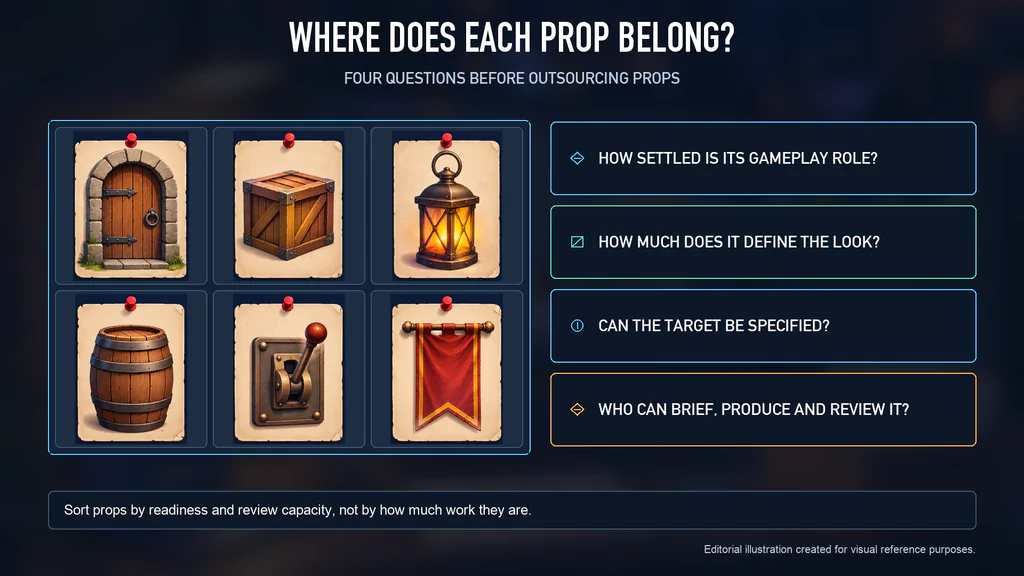
Before any table or estimate, each group of props can be sorted with four questions. They are simple on purpose, because the person answering them may be a producer or a founder rather than an artist.
- How settled is its gameplay role? If size, collision or interaction still depend on design decisions, the prop may change again. Identify which requirements are still open.
- How much does it define the look of the game? Some objects establish the shape language that others follow. Others fill space within rules that already exist.
- Can the target be specified? Clear references and requirements make the work easier to estimate and review. If the direction is still “we will know it when we see it”, the target needs to be defined first, internally or through a separately scoped collaboration.
- Who can brief, produce and review it? Check briefing and review capacity as well as asset-production time. An internal artist who could model the prop but has no free time in the schedule is not, on their own, a reason to keep it in-house.
Open gameplay or visual decisions are the ones to keep under close control. That does not mean every model has to be built in-house: it means the team that owns the decision approves the result. Groups with stable, specifiable requirements are natural candidates to send out, and the next section turns these questions into a starting table.
“Editorial illustration created for visual reference purposes. It does not represent a real project, client work, or official software screenshot unless stated otherwise.”
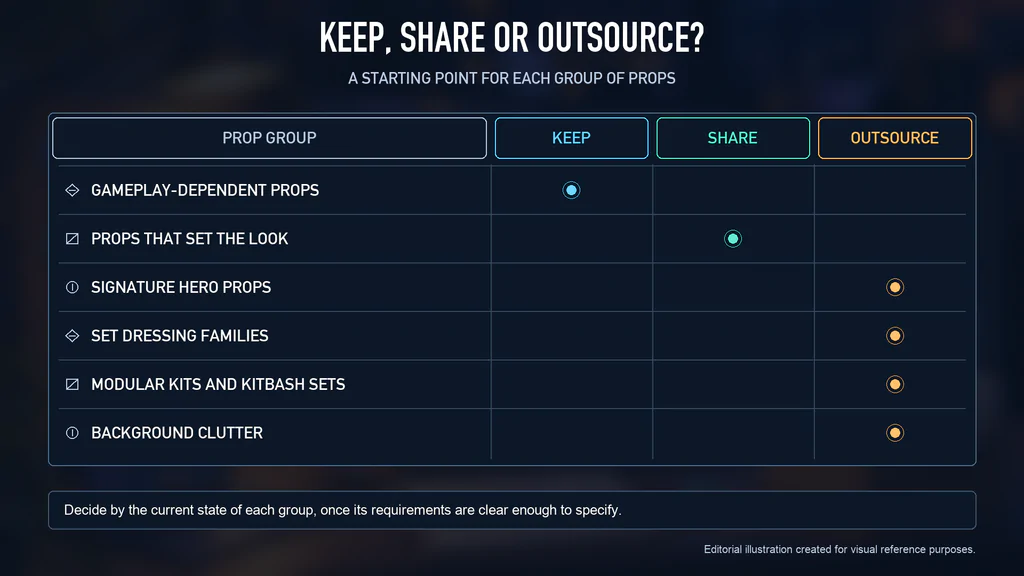
The table describes prop groups by their current state rather than by quantity, because the same logic applies whether a group holds a handful of objects or a level’s worth of them.
| Prop group or current state | Practical starting decision | What must be clear before final production | What the client still owns |
| Gameplay-dependent props with unresolved behavior | Keep design decisions with the gameplay team; scope external prototype work separately if useful | Intended behavior, dimensions, interaction and collision requirements | Gameplay decisions and approval of the relevant tests |
| Props that establish the visual language | Share the work, or commission a defined art-direction step before volume production | References or a benchmark, the exploration scope and an authorized decision owner | Approval of direction and time for review |
| Close-view or signature hero props | Commission once the target is clear; include an early hero if hero production is the purpose of the engagement | Intended camera distance and use, quality target and technical constraints | Approval of the visual target and related gameplay decisions |
| Set dressing families | Good candidates once their requirements are stable enough to specify | Intended use, style, scale, placement and any shared materials | Level context and review against the intended scene |
| Modular kits | Commission once compatibility requirements are defined | Dimensions, pivots, connection rules and representative assembly checks | The intended building system and acceptance of how it behaves |
| Kitbash-derived sets | Commission with agreed source parts, adaptation work and outputs | Source availability, required adaptation and visual and technical targets | Approved inputs and the intended use of the results |
| Background clutter | Candidate when relevant to the next production need | Readability, technical constraints and any placement or repetition rules | An agreed level of visual and technical review |
Use the table as a starting point. Visual prominence, gameplay function and production readiness can overlap, so the same asset may need more than one kind of review. In this table, “share” means the internal owner makes the style decision and the partner turns it into production work, with a short review loop between them.
Two rows are easy to merge by mistake. A modular kit is designed around compatible parts and connection rules. Kitbashing uses existing parts to create new assemblies or assets; it does not automatically require one shared grid, although a grid-based scope can be agreed when the project needs one.
Choose a first batch that is representative of the work you need. Avoid making the first commission depend on an unresolved signature design; a well-defined hero prop can still be a relevant first assignment when hero production is the intended scope.
Fun fact: Outsourcing on a small budget is not a new topic. At GDC Europe 2015, the session Indie Outsourcing for Any Budget by Keaton White of Abyssal Arts looked at how small teams can bring in outside talent to build more than they could alone.
Who Holds the Style When There Is No Art Director
A small studio can allocate visual direction in several ways. Three possible allocations show the range.
An in-house approver. A founder, designer or artist can hold approval authority, provided the team has the visual expertise the decisions need or has arranged appropriate support. Reserve time for reviewing the batch rather than assuming the work will fit around other duties.
Partner-led art direction under the studio’s approval. The external team develops the visual rules and proposes key assets, while the studio approves direction at agreed points. Our Wild Rage case documents art-direction work for Whimsy Games, including props. It shows the kind of scope a partner can hold; the allocation of responsibilities for a new engagement still needs to be agreed.
Shared direction. The internal owner approves, the partner proposes and documents. Each style decision is written down once, so the next batch starts from the record rather than from memory.
If visual development or art-direction support is needed, name it in the scope before asset production and agree its outputs, reviews and commercial treatment. A quote for prop production should make clear whether that work is included.
Use approved existing assets as the target where they are available. For a new project, agree a reference target or commission a defined visual-development step, and approve the benchmark before volume production. Either way, a short game art bible with approved references, material notes and examples of what is off-style gives both teams the same reference point.
Scoping the First Batch by Category, Not by Count
“Editorial illustration created for visual reference purposes. It does not represent a real project, client work, or official software screenshot unless stated otherwise.”
A prop count or spending limit does not explain what the first order must demonstrate. Start with the future work you want the partner to take on, then choose representative assets and agree the evidence needed to review them.
The batch should address three questions:

- Visual target. Do the props match the approved references, benchmark or existing set, under the intended viewing conditions?
- Technical fit. Do the agreed files and setup meet the applicable requirements in the specified engine configuration, with integration ownership and any remaining work made explicit?
- Working process. Can both teams turn a submission into a clear decision, a revision where required and explicit acceptance?
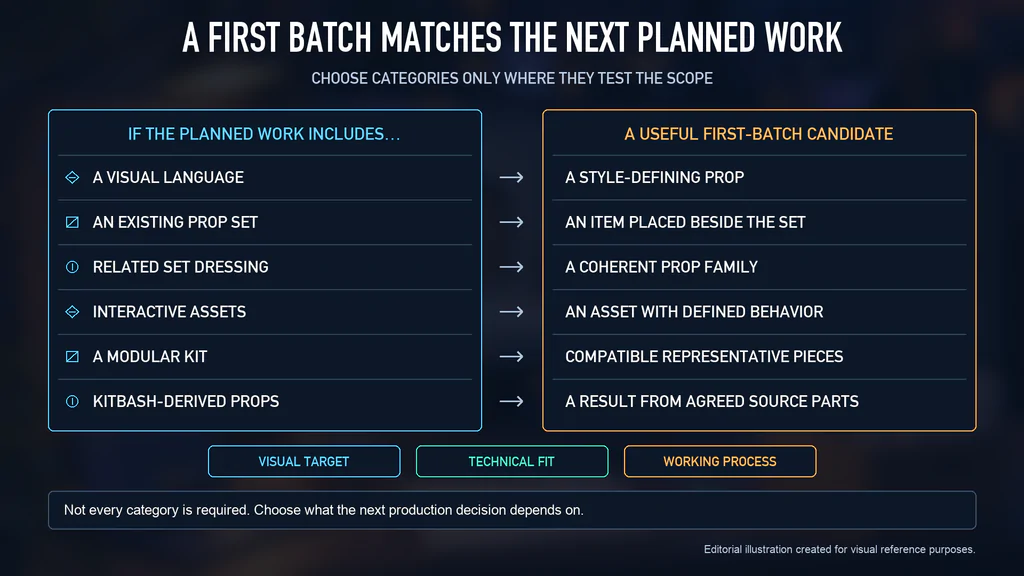
Choose categories only where they test the intended scope:
| If the planned work includes… | A useful first-batch candidate | What to check |
| Establishing a visual language | A representative style-defining prop or benchmark | Whether the approved direction is specific enough to guide further production |
| Extending an existing prop set | A representative item or family placed beside the approved set | Proportions, material response and consistency with the baseline |
| Producing related set dressing | A coherent family representative of the later work | Consistency across the family and any shared-material requirements |
| Interactive assets | An asset with sufficiently defined behavior | The agreed collision, pivot and interaction checks, and who owns integration |
| A modular kit | Compatible pieces representative of the intended connections | Dimensions, pivots, fit and the agreed assembly rules |
| Kitbash-derived props | A representative result assembled from the agreed source parts | Required adaptation, visual consistency and technical fit |
These are selection options, not a requirement to order every category. A style-defining prop can also be a hero or an interactive object; the roles overlap. Choose a batch whose review you can support and whose results are relevant to the next production decision, and do not commission final polish against assumptions that are likely to change.
When the plan moves on to quantities and kits, our guide to props and weapons scope estimation covers the breakdown into a countable production scope.
For an existing library, our published approach starts by reviewing the assets, specification and art bible already in place, then producing a small calibration batch, and scaling up only once that batch matches what the team already has in the build.
What to Prepare Before You Ask for an Estimate
Prop costs become hard to predict when the target is undefined, requirements keep moving or feedback changes direction after approval. Clear inputs reduce avoidable ambiguity before the estimate is written, even if they cannot remove every open question.
From the material side, prepare:
- an asset list grouped by category, even if it is rough;
- the intended use of each group and the relevant viewing or interaction conditions;
- reference or concept art, and a style target: existing assets where available, or an agreed reference target for a new project;
- the split between hero props, set dressing and clutter;
- an art bible or style notes, if you have them, and whether any set should be modular or kitbash-based;
- your technical specification, target platform and engine, with relevant tool and engine versions;
- the required deliverables: source files, exports or engine content;
- screenshots of existing props in your in-game lighting and your naming, pivot and folder conventions, where available;
- who performs integration and which checks the receiving team will carry out;
- dependencies or source parts that must be available, explicit exclusions and decisions that are still open.
From the decision side, identify the required reviewers and the person authorized to give final acceptance. Define the visual and technical results the first batch must demonstrate, the agreed delivery package and how open questions will be resolved.
Agree the review checkpoints and the revision arrangement, including how corrections against the baseline, planned refinement and changed requirements will be handled. Our published terms set the number of revision rounds in the project agreement and treat work as complete and accepted once the client gives written final approval. That gives both sides an explicit point at which the batch is done.
Where the Trap Is: Final Art Before Gameplay Settles
“Editorial illustration created for visual reference purposes. It does not represent a real project, client work, or official software screenshot unless stated otherwise.”
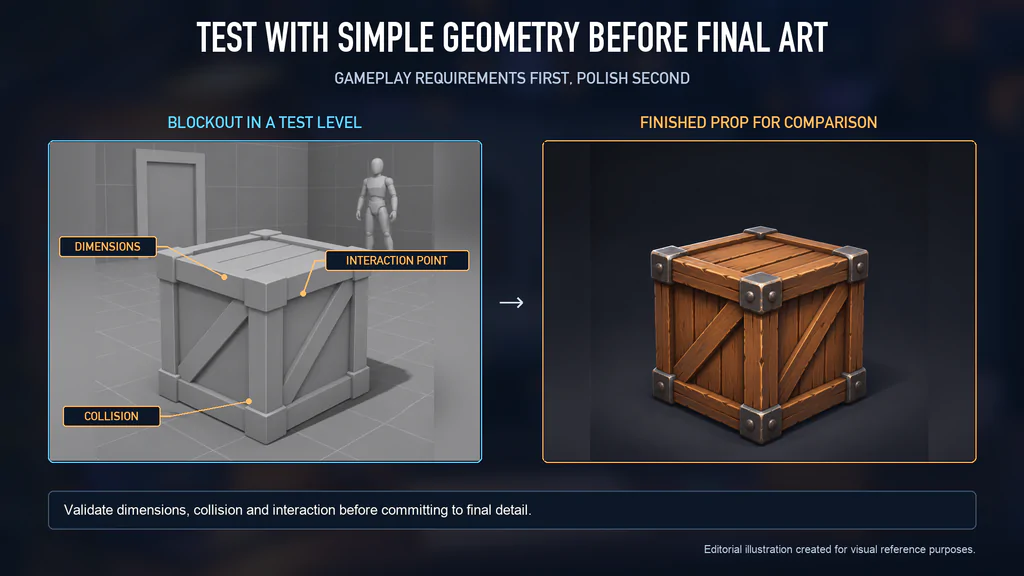
Gameplay-dependent props need requirements that can be tested: dimensions, collision, interaction points and readability in the intended context. A cover object, a door or a climbable crate has to work in play before it is finished for the eye. If those requirements change after final art, some of the work may need revision, so identify that uncertainty before commissioning final detail.
For a first final-art batch, validate the relevant behavior with simple geometry before committing to polish. The gameplay team should own the design decision; the blockout itself can be made internally or commissioned as a defined prototype task. If iteration is part of the engagement, agree how it will be reviewed and handled.
Unreal Engine’s Modeling Mode, for example, provides tools for creating and editing meshes directly in the editor. Epic labels the feature Beta and advises caution when shipping with it, so the suitability of a particular workflow and its outputs needs validation for the project.
For producers, the practical step is to record, before an asset enters the first final-art batch, which of its requirements are defined and which remain open. Unresolved gameplay work can still be commissioned separately when that is the agreed scope. For a publisher-facing build, choose the assets that need final quality against the actual demonstration goal; our guide to vertical slice art scope covers that decision.
After the First Batch: What to Hand Over Next
After the first batch, use the results to decide whether the partner is ready for the next relevant work. Prioritize against milestone needs, requirement readiness, dependencies and review capacity. A batch that proves one workflow does not automatically validate every other asset type, so expand the scope when the evidence supports that decision.
At this stage the question changes from “what do we send” to “how do we keep sending it”. A defined asset list with a fixed deadline fits a project-based order. A production where the prop list keeps growing across milestones fits ongoing support, where the same team keeps your conventions instead of relearning them with each order.
Two of our case pages describe props produced to a client’s established requirements:
- For La Quimera, we created props and weapons for Reburn in accordance with the project’s technical requirements and distinctive visual style.
- For Mutant Year Zero: Road to Eden, we delivered weapons, props and environment assets for The Bearded Ladies in line with the project’s technical standards and visual style.
These case descriptions document assets produced to each project’s visual and technical requirements. For a first batch, the relevant check is whether the agreed assets meet your own approved target and delivery specification.
How We Work With Small Teams on Props
Our 3D props outsourcing work covers hero and interactive objects, set dressing, clutter, modular kits and kitbash sets, in realistic and stylized styles. For an existing library, our published approach starts with reviewing its assets and conventions and agreeing a calibration batch before scaling. Where the visual target still needs development, we discuss the required concept or art-direction work as part of the scope, together with review and approval responsibilities.
Three Ways to Hold Art Direction on a Small Team
These are possible allocations rather than exclusive models. In each, agree who develops the direction, who reviews it and who has final approval authority.
| Allocation | Who decides day to day | What the studio must provide | Main risk | Fits when |
| In-house approver | A founder, designer or artist with approval authority | Scheduled review time, the needed visual expertise or support, and a written style record | Review slips when the approver’s other work takes priority | The team has a clear vision and someone who can commit time to it |
| Partner-led art direction | The partner, within direction the studio approves at agreed points | A clear brief, references for the intended feel, timely approvals and an agreed scope for the direction work | The look drifts from the founders’ intent if approvals are skipped | The team knows the feel it wants but lacks in-house capacity to define production rules |
| Shared direction | The internal owner approves; the partner proposes and documents | One approver and agreement to record each decision once | Decisions stay verbal and are lost between orders | The team wants the final word but cannot spend days on every question |
A studio can also move between allocations, for example starting with partner-led direction while the style is defined and moving to shared direction once the rules exist and an internal owner has time for them.
Planning Your First Props Order?
To request a quote, share your asset list grouped by category, references, target engine and platform, technical requirements and expected delivery package. Include representative props from your build if available; otherwise describe the visual target and any art-direction support you need. The initial consultation is free, and we can discuss the proposed scope and first-batch priorities before you commit to production.
Write to sales@nastyrodent.com or use our contact form. We usually reply within 1–2 business days.
See the stylized props we build for games →
Let's work
together


in mind?
From 3D characters and environments to weapons, props, concept art and game UI/UX: ten years deep, 40+ artists strong, zero fluff. Tell us what you are making and get a free, no-pressure estimate.
estimate