3D Environment Art Outsourcing: Vendor Selection Guide
-

Written by Denys Zadoienyi
-

Updated on06.08.2026
-

Time to read15 min

- Why Environment Art Vendors Need a Different Screening Process
- Portfolio Red Flags Specific to Environment Art
- The First Technical Call: Comparing Candidates Side-by-Side
- Designing the Paid Screening Trial
- World Partition Readiness: What to Actually Verify
- Screening Snapshot: Weak Evidence vs. Strong Evidence
- What Happens After You Pick One
When a mid-core or AAA studio starts comparing 3D environment art outsourcing vendors, the comparison often happens at the wrong level. Portfolios get scored on beauty shots. Pricing gets compared line by line. Availability gets confirmed. Then a production engagement begins, and weeks later the first delivered kit reveals a texel density that shifts from asset to asset, a texture budget that was never actually tracked across the set, and a pipeline that has never been tested against a streaming world like yours. None of that is reliably visible in a portfolio review – it surfaces once budget and calendar time are already committed.
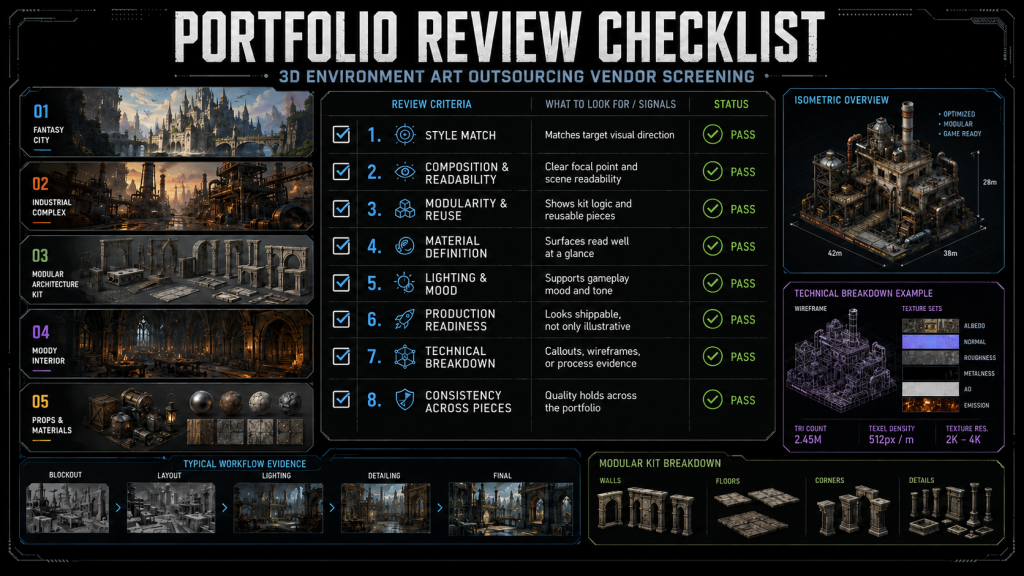
“Editorial illustration created for visual reference purposes. It does not represent a real project, client work, or official software screenshot unless stated otherwise.”
This guide covers the stage before that commitment: comparing candidates side by side, before you’ve picked a finalist for a production Statement of Work. That stage has two distinct layers, and conflating them is where a lot of screening processes go wrong. Public portfolio review and a high-level technical call can happen without an NDA, as long as no confidential project information is shared. The moment you want to test a candidate against your own reference material through a small paid trial, that’s already a contracted engagement, even if it’s far smaller than a production SOW, and it needs its own lightweight agreement covering confidentiality, payment, and IP ownership. This guide walks through both layers: what to look for in a portfolio, how to run a comparable technical call across several candidates, and how to scope a paid trial that’s properly documented and still small enough to run before you’ve committed to one vendor.
The logic here applies whether you’re comparing a boutique environment specialist or a full-service 3D game art outsourcing studio that happens to run a strong environment team – what changes is the depth of the environment-specific answers you should expect back, not the screening structure itself.
Why Environment Art Vendors Need a Different Screening Process
Individual character or prop defects are often easier to isolate – a hero character either reads correctly or it doesn’t. Environment art doesn’t have that containment by default nearly as often: a modular kit with inconsistent texel density or a texture budget that was never tracked across the set is reused across a level, so the problem is reused with it, and by the time it’s caught, dozens of placements may already depend on it.
That’s the reason a generic game art outsourcing checklist – portfolio, pricing, communication cadence – isn’t sufficient on its own for environment work. It’s a necessary baseline, not a complete one. Environment art carries a second layer of risk that only shows up once you look at how a studio handles volume: whether they think in terms of a single asset’s budget or in terms of a scene’s budget, and whether that difference was ever part of their process before you asked about it.
If your project centers on modular kits, large-zone compositions, or a UE5 pipeline built around streaming, the vendor you shortlist needs to demonstrate that thinking before you request a formal quote – not after.
Portfolio Red Flags Specific to Environment Art
A portfolio review for environment art needs a different eye than a portfolio review for characters or props, because the failure mode is different. A character portfolio can hide weak fundamentals behind a strong pose and good lighting. An environment portfolio can hide the same weak fundamentals behind a strong single hero shot – while the rest of the scene, the part that actually has to hold up under player scrutiny, never gets shown.
A few patterns worth checking for before you move a studio to your shortlist:
Architectural visualization dressed up as game art. Interior and exterior scenes with beautiful lighting but no visible geometry budget, no wireframe, and no in-engine screenshot are common in general 3D outsourcing portfolios. Archviz and game-ready environment art solve different problems – one optimizes for a single hero render, the other for a scene that has to run in real time from multiple angles under gameplay conditions. If every piece in the environment section of a portfolio is a static beauty render with no supporting technical view, treat that as a signal to dig further, not as confirmation of skill.
No modular thinking visible. A single striking hero environment tells you the studio can build one good scene. It doesn’t tell you whether they can build a kit – a set of pieces designed to tile, combine, and reuse across a level without visible repetition. Ask specifically for modular kit examples, not just finished environments, and ask how many unique pieces made up the kit versus how much of the final scene came from reuse.
Visibly inconsistent detail level within a single scene. A beauty render alone can’t confirm an actual texel density value – that needs scale information, UVs, or a density visualization – but visible inconsistency is still a legitimate flag: a nearby wall and a nearby prop that clearly don’t match in sharpness at the same viewing distance suggest density wasn’t planned as a set-wide decision. A Polycount discussion among environment artists illustrates how practitioners often approach this: as a project-specific texels-per-unit target defined early enough to guide UV and texture work, with deliberate exceptions for hero pieces, trim sheets, or background geometry. If a portfolio shows the inconsistency and the studio can’t explain whether it was a deliberate exception, that’s the actual signal worth following up on.
No engine-context shots. Marmoset or Substance Painter beauty renders look good under controlled studio lighting that has nothing to do with how the asset behaves under your project’s actual lighting setup. A studio that only ever shows pre-engine renders either hasn’t validated their own work in-engine, or is choosing not to show you what that validation looked like. Either way, ask directly for in-engine screenshots as a follow-up before scheduling a call.
None of these red flags are disqualifying on their own – a studio transitioning from film or archviz work into games may have strong fundamentals and simply lack game-specific portfolio pieces yet. What matters is whether the studio can speak to these gaps directly when asked, rather than deflecting the question.
The First Technical Call: Comparing Candidates Side-by-Side
Most vendor calls at this stage are run as individual conversations – one studio, one hour, move to the next. That structure makes it hard to compare answers accurately, because you’re relying on memory and notes rather than a direct side-by-side. A better approach: prepare one fixed set of questions and run it identically across every candidate still on your shortlist, in the same order, before any candidate sees your full brief.
The questions worth asking at this stage are narrower than what belongs in a full brief. You’re not yet defining scope – that comes later, and it deserves its own document once you’ve narrowed to a finalist. At the screening stage, the goal is comparative signal, not a scope document:
- How do you establish a texel density target for a new project, and how do you keep it consistent once more than one artist is working on the same environment?
- Walk me through how you’d handle a scene where the reference material doesn’t specify a technical constraint – what’s your default assumption, and who makes that call internally?
- How do you track texture budget across a modular kit as a set, rather than asset by asset?
- Have you delivered environment content into a project that already had its own runtime-grid settings, Data Layers, and content conventions in place – rather than a streaming setup you built from scratch?
Vague or generalized answers to any of these – “we follow industry standards,” “we adapt to whatever the client needs” – are worth noting as a data point, though a studio that’s genuinely strong may simply be unused to being asked this way rather than lacking the underlying process. A studio with a real, repeatable environment pipeline more often answers with specifics: how a density target gets set and communicated, a naming convention example, a description of how a lead artist audits a kit before delivery. That same specificity is what a properly scoped brief should eventually capture in writing once you’ve picked a finalist – unclear briefs are a common source of avoidable revision cycles, and studios that already think this way at the screening stage tend to produce cleaner briefs later.

Designing the Paid Screening Trial
A portfolio review and a technical call establish whether a studio can talk about environment production correctly. A small paid trial, run before you’ve committed to one finalist, establishes whether they can execute it – and it’s a different instrument than the test asset most vendor-selection processes eventually run. That later test asset, the one that happens inside a signed SOW with a single chosen vendor as part of onboarding, exists to validate integration into your specific engine build. The trial covered here happens earlier and answers a narrower comparative question: among the candidates that have already passed portfolio and technical screening, who actually demonstrates the process discipline your project needs?
Because it uses your own reference material rather than public information, it’s a contracted step even at small scale – worth documenting in a written agreement proportionate to the material being shared and the rights involved. Depending on your procurement policy, the trial may not require the full production MSA, but it still needs a written agreement covering, at minimum, confidentiality (if anything project-specific changes hands), scope, payment, acceptance, ownership of the delivered work, and how the result may or may not be used in the vendor’s own portfolio. Getting this in writing is what makes the trial a fair, comparable test rather than a source of disputes later.
Scope it tight enough to run in parallel across finalists, not against one. A representative trial is typically a small modular set – a handful of pieces that need to tile together – rather than a single hero asset, because tiling behavior is where set-wide discipline actually shows up. Keep it small enough to complete quickly and compensate it as paid work; exact scope, timeline, and rate should be agreed individually with each finalist rather than fixed to a specific piece count, since a fair comparison depends on the brief being genuinely representative of your production, not on hitting a round number.
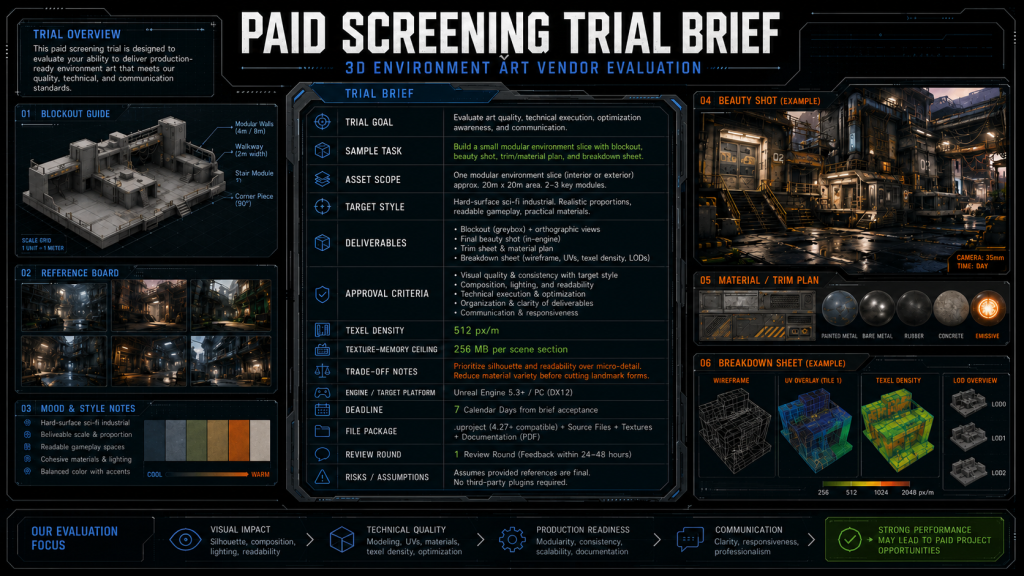
“Editorial illustration created for visual reference purposes. It does not represent a real project, client work, or official software screenshot unless stated otherwise.”
Set a texture-memory ceiling for the full set, not per piece. A total texture memory budget across the whole modular kit – rather than a resolution limit on each individual asset – forces trade-off decisions across pieces, which is the skill that actually breaks down at production scale. This is one specific, measurable axis of a much larger memory footprint that also includes geometry, materials, and collision; the trial isn’t a substitute for a full technical audit, it’s a deliberately narrow test of one thing you can score cleanly on a small sample.
Require a delivery format that shows the work, not just the result. Ask for wireframe views, a density visualization or equivalent, and a short note on any trade-offs made to stay within the ceiling. A studio that hits the target and can explain the decisions behind it in a paragraph is demonstrating a repeatable process. A studio that hits the target with no supporting documentation hasn’t shown you whether the result would hold up across a larger batch.
Score against the brief, not against taste. It’s tempting to evaluate a trial the same way you’d evaluate a portfolio piece – does it look good. The trial exists to answer a narrower question: did the vendor meet the stated constraint, and can they account for how. A visually strong piece that ignores the ceiling has failed the actual test, even if it would score well in a portfolio review – and conversely, a trial that goes smoothly is a strong signal for this one dimension, not a guarantee that a larger, more complex production batch will go the same way.
World Partition Readiness: What to Actually Verify
World Partition only matters to your screening if your project actually streams a large or open world – plenty of environment work happens inside contained, fully-loaded levels where it’s irrelevant, and treating it as a universal UE5 competence test doesn’t fit every project. Where it does apply, “we know UE5” isn’t a qualifying answer on its own, since most vendors will say yes at that level regardless of whether they’ve shipped content into a streaming world specifically.
Epic’s own documentation describes World Partition as storing a world in a single persistent level, subdivided into streamable grid cells controlled by configurable runtime-grid settings and streaming sources. Separately, each Actor’s own loading behavior depends on its Runtime Grid assignment, its Is Spatially Loaded setting, and any Data Layers it belongs to – these determine how an individual Actor participates in that streaming system, distinct from the cell-level streaming mechanics themselves. Cell size and loading range are configured per project rather than fixed defaults – worth confirming a candidate studio actually knows this, rather than assuming every UE5 project streams identically.
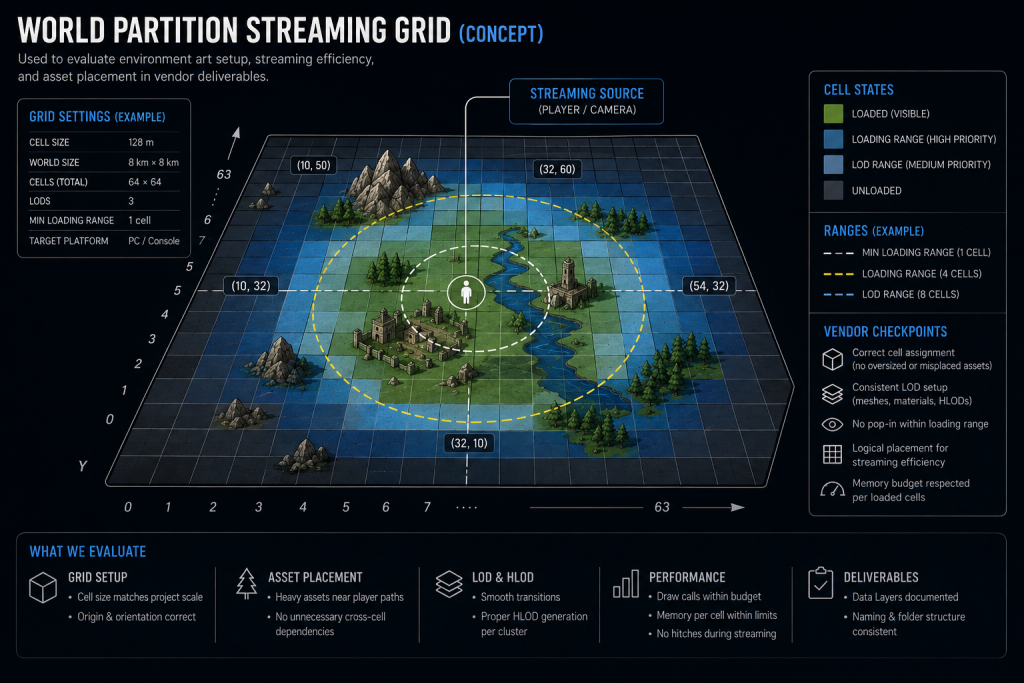
“Editorial illustration created for visual reference purposes. It does not represent a real project, client work, or official software screenshot unless stated otherwise.”
What this means for a screening trial, specifically: if your project streams, add one constraint to the trial brief that requires the vendor to reason about how their delivered pieces would sit inside someone else’s existing runtime-grid settings, Data Layers, and HLOD setup – not a greenfield project of their own design. That’s the gap that tends to separate studios with genuine production exposure from studios that have only built World Partition content for their own demos. The full vendor scorecard on our site goes deeper into evaluating Nanite, Lumen, and World Partition production experience specifically once you’re past screening and structuring the finalist’s onboarding.
Screening Snapshot: Weak Evidence vs. Strong Evidence
The signal isn’t which type of studio you’re talking to – boutique environment specialists and full-service outsourcing studios can both land on either side of this table. What matters is whether a candidate, of any shape, backs its claims with checkable evidence or with reassurance.
| Signal | Weak evidence | Strong evidence | What it tells you |
| Portfolio format | Beauty render only, no wireframe or in-engine view | In-engine screenshots, wireframes, scale and technical notes included by default | Whether pipeline validation is a habit or an afterthought |
| Texel density | “We follow standard practice” | A described process for setting and enforcing a project-specific target across artists | Whether density is actively governed, not assumed |
| Texture budget | Discussed per asset only, if at all | A stated approach to tracking budget across a full modular set | Ability to make trade-offs across a kit, not just one file |
| World Partition (where relevant) | Generic “we know UE5” | A specific example of authoring inside a client’s existing streaming grid | Real production exposure vs. general familiarity |
| Trial response | Meets the constraint with no supporting documentation | Meets the constraint and explains the trade-offs made | Repeatable process vs. a result you can’t yet account for |
Candidates who consistently land in the strong-evidence column are the ones worth advancing to the next formal step in your procurement process – whether that’s an RFP, a paid trial, or direct commercial negotiation, depending on how your organization sequences vendor evaluation. Landing in the weak-evidence column on one or two rows isn’t automatically disqualifying – some of this is simply unfamiliarity with being screened this closely – but any gap that stays unresolved should be written into the eventual SOW as an explicit acceptance criterion, not assumed away.
What Happens After You Pick One
Laid out end to end, the sequence looks like this: public portfolio review and a comparative high-level technical call across candidates, without an NDA where no confidential information is exchanged – then, for the finalists still in contention, a small paid trial under its own lightweight agreement – then vendor selection – then the production SOW and MSA – then onboarding.
That last step deserves its own process, and it isn’t the same one covered here. Once a finalist is selected for a UE5 environment scope specifically, a six-criteria vendor scorecard and a four-week onboarding protocol walks through validating their pipeline against your actual engine build – using one representative test asset under a signed SOW, which is a different exercise from the multi-candidate trial covered above, run at a later stage with a vendor you’ve already chosen.
For engagements spanning multiple asset types beyond environment work, a broader eight-week vendor onboarding structure covers the same ground across characters, props, and concept pipelines. Treating screening and onboarding as one blended step is how studios end up either skipping onboarding entirely (“we already vetted them during screening”) or re-running the same questions twice with no added signal.
The 3D environment art team at Nasty Rodent is set up for exactly this kind of technical screening – comfortable being tested through calls, trial briefs, and constraints that go beyond a portfolio review. If you’re scoping a trial brief and want a second opinion on the texture-memory constraint before you send it out, that’s a conversation worth having before the brief goes out, not after.