Hero Vehicle or Vehicle Kit: How Indie and AA Teams Decide
-

Written byDenys Zadoienyi
-

Updated on16.11.2026
-

Time to read10 min

Choosing between a hero vehicle and a kit for an indie or AA game starts with what players need to recognize and use, and with what your team can afford to build for the first playable. Get the order wrong, and the budget goes into detail nobody sees or into a fleet the game did not need yet.
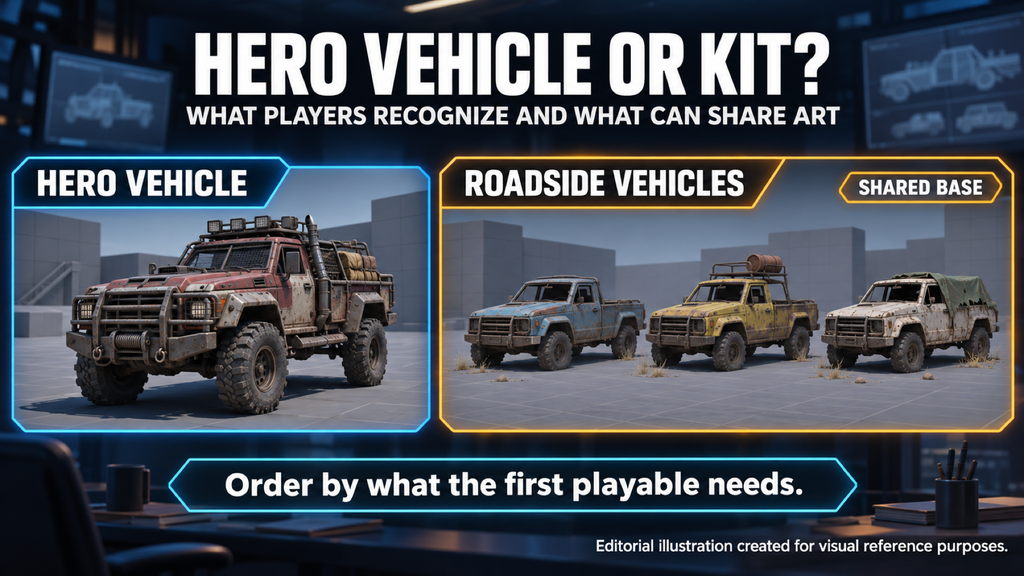
“Editorial illustration created for visual reference purposes. It does not represent a real project, client work, or official software screenshot unless stated otherwise.”
A hero vehicle is a focal vehicle whose role or visibility justifies a distinct design and focused art effort. A vehicle kit is a family of vehicles built from a shared base or compatible parts. A hybrid fits games that need both: a distinct hero and a separate family that can share art.
Choose What to Order First
Work from the first playable, not from the full vehicle list: decide which vehicles need a distinct design, then whether the rest can share art.
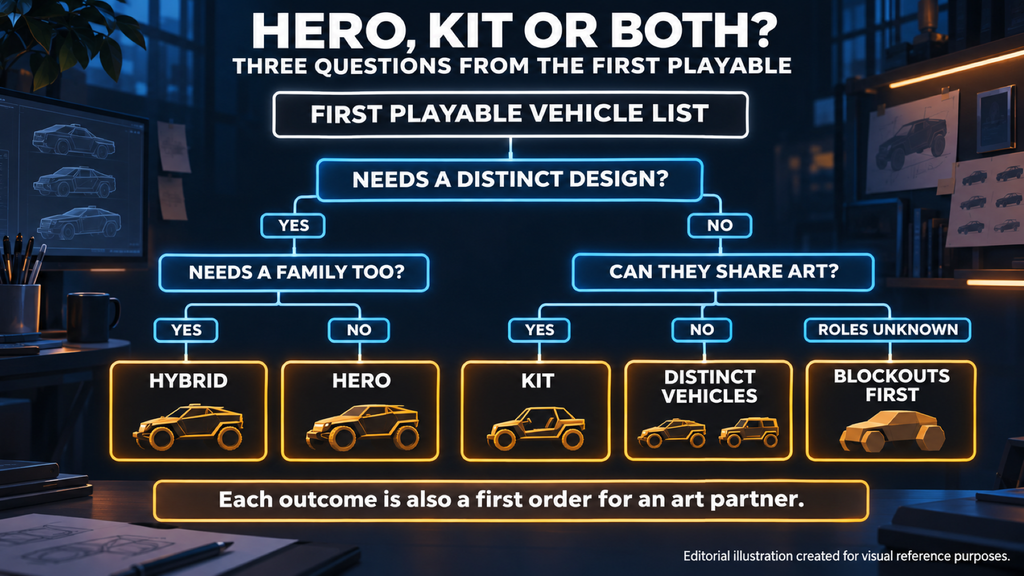
List the vehicles the first playable actually needs. For each one, note what the player must recognize or do with it, and from which view. Then take these decisions in order.
- Does a vehicle need a distinct design for players to recognize it or use it as intended? If yes, mark it as the hero candidate and go to question 2. If no, go to question 3.
- Does the same build also need a family of similar vehicles? If yes, and those vehicles can share art without losing the differences players need to read, choose a hybrid: scope the hero separately and start the family with one representative vehicle. If the build only needs the hero, order it first. If it also needs vehicles that cannot share enough art to form a kit, scope those as separate assets and include only the ones the build needs.
- Do the vehicles need to look different while sharing enough art to justify a family? If yes, choose a kit and approve one representative variant before ordering the rest. If no, order the smallest set of distinct vehicles the build needs. If their roles are still unknown, start with blockouts and revisit the list after playtesting.
“Editorial illustration created for visual reference purposes. It does not represent a real project, client work, or official software screenshot unless stated otherwise.”
The tree ends in one of five outcomes: a hero, a kit, a hybrid, a short list of distinct vehicles, or blockouts until the roles settle. Each outcome is also a first order you can hand to an art partner, which is why the tree starts from the first playable rather than from the whole game.
If you are a founder making this call without a dedicated art director, answer question 1 with whoever owns the design and question 3 with whoever will approve the art. The first question is about play; the third is about what the art can share.
Whether parts can actually be shared is a production question with its own limits. Our technical guide explains what a shared base saves and where it stops; this article stays with the decision that comes before it.
What Two Driving Games Show
Two published interviews show both ends of the tree: one game built around a single vehicle, and one that offers many vehicles with similar behavior.
In Game Developer’s interview with the Pacific Drive team, Ironwood Studios creative director Alex Dracott said the team thinks of the game’s station wagon as a character, and that core parts of the car are not hard to swap out.
Read through the tree, that is a hero vehicle with an upgrade set: one body players get attached to, and parts that change it over time. The upgrades do not turn the car into a fleet. For a team ordering art, the practical consequence is that the parts belong to the hero’s scope, so how many there are and how they attach matter as much as the body. That is our production reading, not a description of how Ironwood planned its art.
In 80.lv’s interview with Brinemedia, the Ukrainian studio’s developers describe the opposite choice for Stunt Paradise 2. They dropped the idea of very different handling, because changing a car’s physics changed how levels played, kept the vehicles’ baseline physics similar and treated vehicle variety mainly as visual expression.
Similar behavior does not tell you how much art the cars share, and the interview does not say. The developers describe visual variety as the main way the vehicles differ. When that is true for your game, question 3 decides whether those visual differences can come from one family or need separate designs.
Where the Art Effort Goes
A hero puts the effort into one design, a kit puts it into shared rules and checks before the second vehicle, and a hybrid splits it between the two. That is where the cost differs, before anyone quotes a number.
A hero vehicle concentrates detail where players look: the silhouette they recognize, the parts they use and the surfaces they see up close. The risk is the concentration itself. If gameplay later changes the vehicle’s size, role or number of seats, the most detailed asset in the game is the one that has to be reopened.
A kit moves the work to the front. Someone has to decide what the vehicles share, which parts must fit more than one body and how each vehicle still reads as different. That setup pays off when the game needs several vehicles that can share enough art. With a few vehicles that share little, it can cost more than building them separately.
A hybrid carries two scopes and one dependency. The hero sets the look; the family has to follow it without copying it. If the family is designed too independently, it can need another pass to match the hero once both sit in the same scene.
Visibility decides where extra effort is worth it. A vehicle players watch for long stretches, see in a menu or meet in a key story scene can justify a distinct design even if it appears briefly. A vehicle that passes as traffic or an obstacle seldom needs the same depth.
Style shifts what carries the difference between vehicles. Stylized vehicles lean on silhouette, proportion and color blocking, so variants can separate through shape and paint. Realistic vehicles depend on reference accuracy and material detail, so a convincing variant often needs more than a color change. Our comparison of stylized and realistic production shows how that choice moves the rest of the art budget.
Set the Style Reference Before the Second Vehicle
A vehicle family stays coherent when one person approves a visual reference and writes down its rules before the second vehicle is made.

The rules do not need to be long. Record the proportion system, how far the stylization goes, the palette and wear language, the level of detail each role gets and how parts are named. Without them, each vehicle can look right when it is approved on its own and still look like it belongs to a different game when it sits next to the others.
If you are a founder acting as art director, give one person the final say on every vehicle, and approve the first family vehicle before the rest are started. When we join a set of vehicles that already exists, we start the same way: one calibration vehicle matched to the assets you have, then the rest of the set built from it.
The wider question of who holds the style on a small team works the same way for props and vehicles. With vehicles, a rule missed on the first approved design tends to repeat in every variant built from it.
Plan the Launch Order
“Editorial illustration created for visual reference purposes. It does not represent a real project, client work, or official software screenshot unless stated otherwise.”
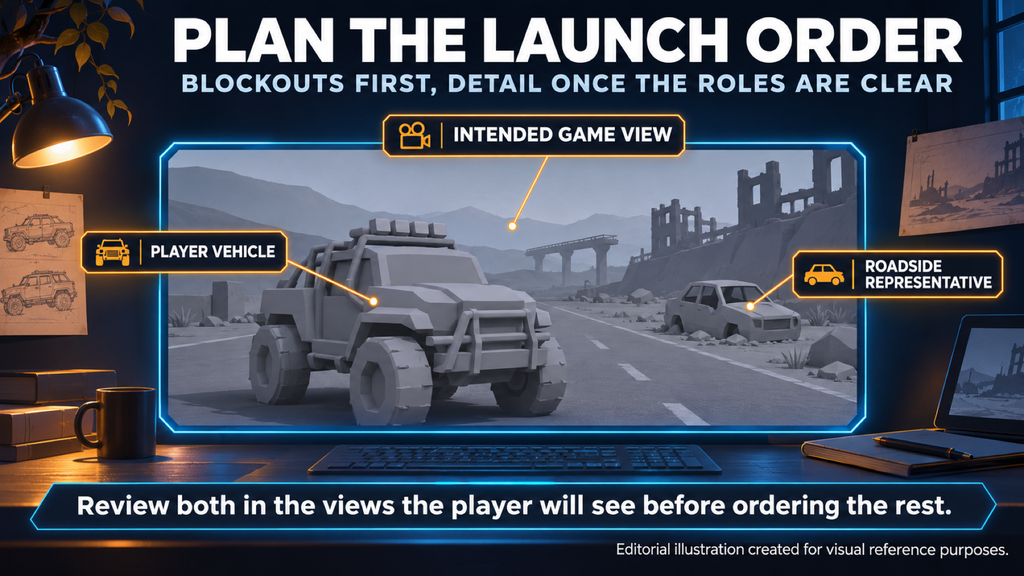
Prototype the vehicle that matters most to the first playable, add one representative of a planned family if the build needs variety, and review both in the intended game views before ordering the rest.
The first build usually needs the player’s vehicle in blockout form and, if the scene depends on variety, one representative roadside or enemy vehicle beside it. If a vehicle’s role is still changing, keep it as a blockout: simple shapes are easier to change than finished art. Our guide to scoping art for a vertical slice shows how to separate what a slice needs from what launch needs.
Ordering in the wrong sequence costs twice in a quiet way. A detailed hero ordered before its role settles may come back for new proportions; a family ordered before the hero sets the look may need a pass to match it. For a founder, that is budget spent before the first playable proves anything. For a producer, it is review time on a milestone with no new feature to show.
If the roadmap adds upgrades or vehicles after launch, name what the first order needs to support and what can wait. As a producer, flag one case early: an approved vehicle that later has to take parts it was not designed for. Fitting them can mean reopening work that was already signed off.
For a fictional vehicle, agree early which parts may change and where they attach. Concept work that resolves how parts fit settles this on paper, before modeling commits the design.
A Vehicle Plan for a Fictional Game
“Editorial illustration created for visual reference purposes. It does not represent a real project, client work, or official software screenshot unless stated otherwise.”
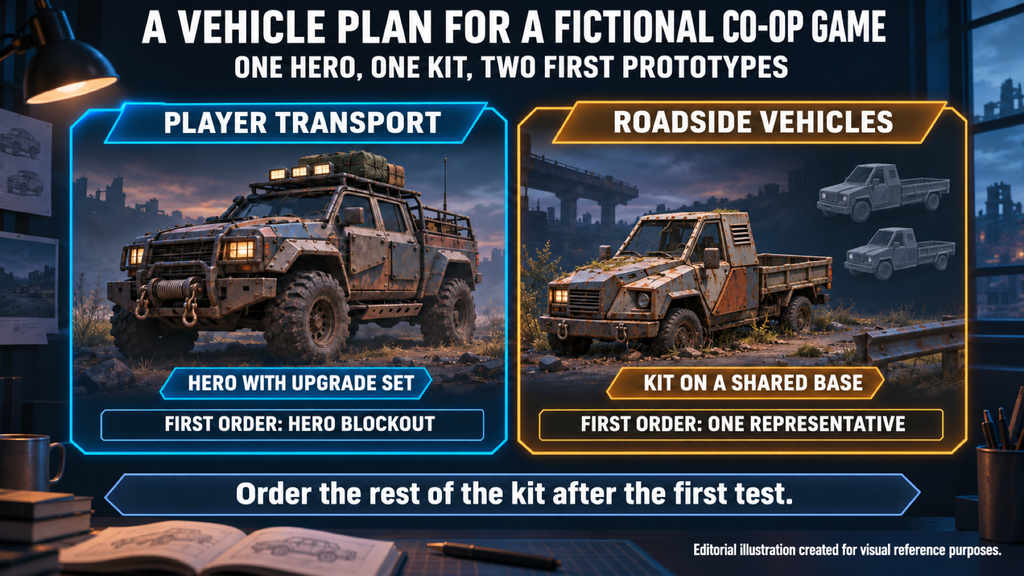
In this cooperative survival game, players travel in one vehicle and pass abandoned vehicles along the route. The transport needs a distinct identity and the route needs a family of recognizable silhouettes, so the tree points to a hybrid.
Illustrative example, not a client project.
| Decision | Player transport | Roadside vehicles |
| Role in the first playable | The vehicle players use throughout the run | Cover, obstacles and landmarks |
| What players need to recognize | Their own vehicle and the upgrades they choose | Distinct silhouettes as they pass |
| Outcome of the tree | Hero with an upgrade set | Kit on a shared base |
| What to order first | One hero blockout | One representative of the proposed kit |
| What to decide before expanding | Which upgrades belong in the first release | Whether variants stay readable while sharing a base |
| Who approves the next order | Creative lead | The same creative lead, reviewing the kit beside the hero |
The first order covers the two prototypes. The rest of the kit is ordered once the team has tested whether the shared art gives the route the variety it needs.
Realistic and Stylized Vehicle Work
For Corruption 2029, The Bearded Ladies’ turn-based tactical game, our focus was realistic vehicles and weapons, aligned with the project’s technical requirements and visual direction.
The second project sits at the other end of the style range.
On Wild Rage, a stylized survival MMORPG for Whimsy Games, we led the art direction for Wild Rage, with vehicles among the areas we covered alongside concept art, characters, weapons, props and environment assets.
Our Approach
We build 3D vehicle art for indie and AA teams as single hero vehicles or full fleets, realistic or stylized, matched to the set you already have. Tell us which vehicles your first playable needs and what you plan after launch, and we will scope the hero, the kit or both.
Request a Vehicle Art Quote
Send us your vehicle list, the role each vehicle plays, your target engine and platform, and any references you have. Tell us which vehicles your first playable needs and which can wait, and we will help you scope a hero, a kit or both and estimate the agreed work. The initial consultation is free.
Request a Quote
You can also write to sales@nastyrodent.com or use our contact form. We usually reply within 1–2 business days.
Let's work
together
in mind?
From 3D characters and environments to weapons, props, concept art and game UI/UX: ten years deep, 40+ artists strong, zero fluff. Tell us what you are making and get a free, no-pressure estimate.
estimate