

Blog - Page 2
Discover behind-the-scenes stories, expert tips, and the latest trends in game art production, design, and development.
Material Editor in Unreal: PBR Materials Without Code
“Editorial illustration created for visual reference purposes. It does not represent a real project, client work, or official software screenshot unless stated otherwise.” A game with two hundred props doesn’t necessarily need two hundred independently authored materials – reusable master materials and material instances can cover whole families of assets that share compatible material requirements. […]
10.09.2026
LOD (Level of Detail) for Real-Time 3D: Polygon Budget Guide
Most polygon budget conversations start with the wrong question: “how many polygons should this asset have?” There is no single answer, because the number depends on the asset’s role in the scene, the platform it ships on, how long and how closely the camera actually sees it, and which LOD tier is being measured. A […]
09.09.2026
Character Rigging Explained: AAA Pipelines
Character rigging is the process of building the internal skeleton, deformation system, and control structure that lets a static 3D character mesh move, pose, and animate inside a game engine. A model without a rig is a sculpture – rigging is what turns it into something an animator can actually direct, and something a game […]
08.09.2026
How to Read a Game Art Studio’s Estimate: Line Items Explained
“Editorial illustration created for visual reference purposes. It does not represent a real project, client work, or official software screenshot unless stated otherwise.” Reading a game art outsourcing estimate is a different skill from comparing two estimates against each other. Comparing quotes is about spotting why two numbers differ – billing model, assumptions, team composition […]
07.09.2026
How to Estimate Game UI/UX Scope Beyond Screen Count
Game UI/UX scope estimation is the process of turning a game’s interface requirements into a brief a studio can actually plan and price against. Screen count is where most briefs start, but it is only one input among several – reusable components, meaningful interaction states, platforms and input methods, localization requirements, accessibility needs, and delivery […]
04.09.2026
How Many Concept Art Iterations Does a Project Actually Need?
Concept art scope estimation is the process of working out, before a brief goes out for quote, how many iteration rounds a specific piece of concept work actually needs – based on what stage it’s at, how clear the direction already is, and what type of asset it is. A brief that simply says “include […]
03.09.2026
Turning a Props and Weapons Asset List Into a Kit You Can Schedule and Reuse
Props and weapons scope estimation is the process of translating an asset list into a kit structure – base pieces, modular attachments, and variants – plus a reuse plan across current and future titles, before a schedule or a quote gets built against it. An asset list that reads “40 weapons and 60 props” isn’t […]
02.09.2026
Turning a Character Roster Brief Into a Production Scope You Can Schedule
Character art scope estimation is the process of translating a character roster brief into a structured production plan – production tier, anatomy and rig class, unit complexity, and reuse volume – before a schedule or a quote gets assessed against it. A brief that lists character names and one-line descriptions isn’t a scope. It’s an […]
01.09.2026
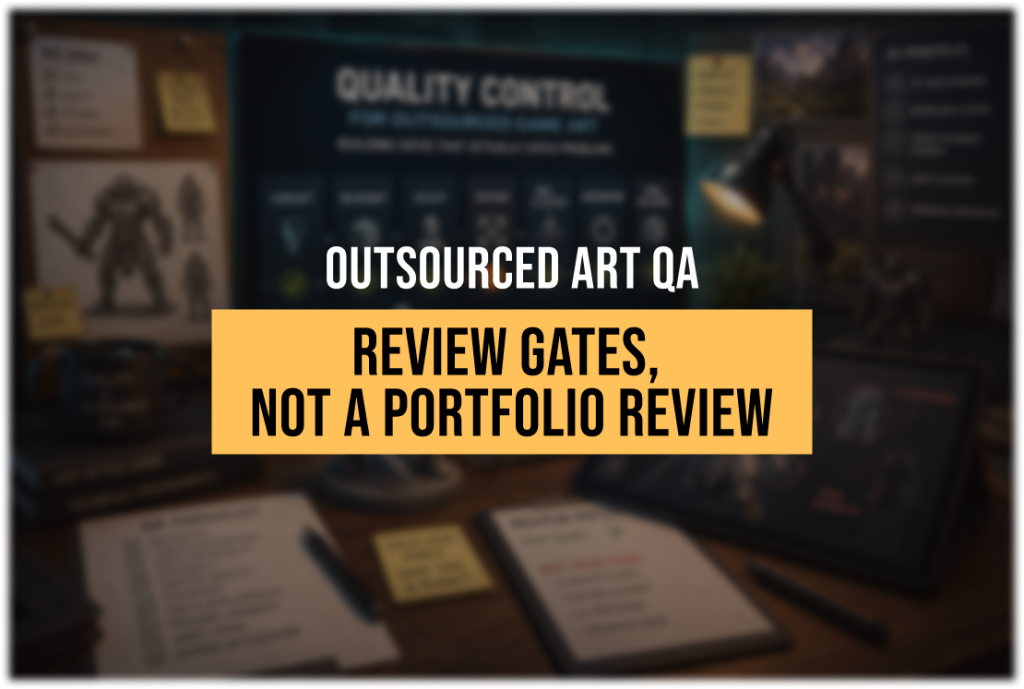
Quality Control for Outsourced Game Art: Building Gates That Actually Catch Problems
“How do I know they’ll do it well” is usually answered with a portfolio review, and a portfolio review is the wrong tool for the question being asked. A portfolio shows the quality level a studio has demonstrated, but not necessarily how consistently it reaches that level across milestones, revisions, and production pressure. Quality control […]
31.08.2026
Not sure where to start
or worried about
the estimate?
No pressure — just send us your idea or a rough brief, and we'll get back with a free consultation and a flexible estimate tailored to your goals.
- Transparent pricing
- Honest feedback
- No hidden costs - ever