
Props in Video Games: Storytelling and Production
-

Written by
-

Updated on27.11.2026
-

Time to read11 min

Introduction
Today, we’d like to talk about creating props for video games and the different approaches you can take depending on the project, genre and budget. These are the assets players encounter most often. From furnishing a small room to building entire cities and worlds, props are everywhere.
We’d also like to look beyond production itself and talk about why these assets deserve attention. They add the finishing touches to the atmosphere and visual story of your world. They can tell us something about a character, a location or an event, and are part of the story themselves.
What props are and how they tell stories
To start with, I’d divide props into three broad categories: quest props, narrative props that tell us about the story or lore, and set dressing. These roles can affect the team’s approach and how much attention each asset receives. This is just a useful way to organize the discussion, rather than a set of established industry terms. And, of course, a single object can serve more than one of these purposes.
Quest props, as the name suggests, are things players need to progress through the story. In Resident Evil 2 Remake, for example, you need to find a valve handle to shut off the steam and get further into the police station, or a key that opens up new rooms and routes. These are objects the player has to interact with to get through a particular part of the game.
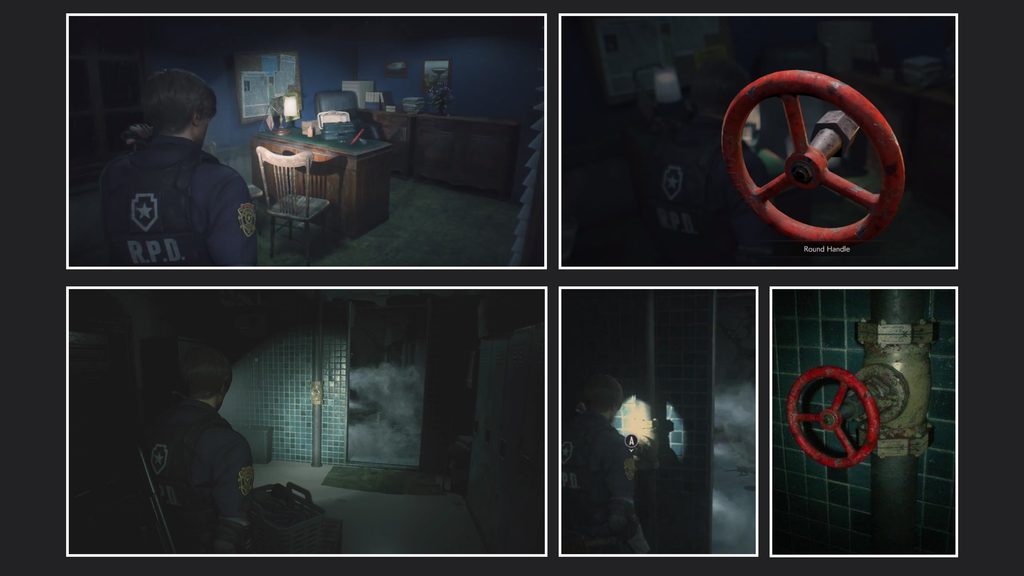
Screenshot from Resident Evil 2 (2019). © CAPCOM CO., LTD. All rights reserved.
Of course, that includes side quests, as well as props in multiplayer games that let players interact with the environment. Take stone, for example: a resource you can use to build a fortress, or a little house where you can hang out with other players. So, for our purposes here, a quest prop is an object the player interacts with to make the next action possible.
Now, let’s look at props that tell us about your game’s story or lore. Ideally, all the props should fit into a coherent picture and give us a sense of where we are and what might have happened here. But I want to single out the ones deliberately used to tell part of a particular location’s story, or directly connected to the main story and the world’s lore.
To make the distinction clearer, imagine an ordinary used coffee mug on a desk. Now imagine the same mug with a corporate logo on it, say Umbrella’s. Perhaps it even has someone’s name on it. Or there’s a shelf full of unremarkable books, but one stands out because its title means something in this world, and there might be a note from its owner inside. It doesn’t advance the plot, and missing it won’t affect the gameplay, but it tells you something about the person who lived here.
Of course, some notes do let you take a specific action: a safe code or a clue, for example. Personally, I’d put those in the quest prop category, because they allow the player to do something. The objects I described before that are the ones I’d call narrative props.
Then there’s set dressing. In many games, this is the largest asset category by sheer volume. You can end up needing far more of these objects than weapons, vehicles or other types of assets. Giving these objects such a broad label doesn’t make them any less important. They create the overall atmosphere and detail of a space. However good your environment is, without these props it will look empty and lifeless, unless that’s a deliberate artistic or narrative choice.
Naturally, how many objects you need and how densely you fill the frame depend on both the genre and the camera. Set dressing also supports the categories above. A desk lamp might light up the key you’ve been looking for, while the everyday objects around it help tell the story of the place.
I really like how Resident Evil 7 handles this when we enter the Bakers’ house. There’s a pile-up of familiar household objects, all treated in a way that supports the art direction and makes the house feel neglected. The fridge full of disgusting leftovers, or the “festive” dinner table with the Baker family gathered around it. We see it all through the character’s eyes, including food you certainly wouldn’t expect at an ordinary family dinner.
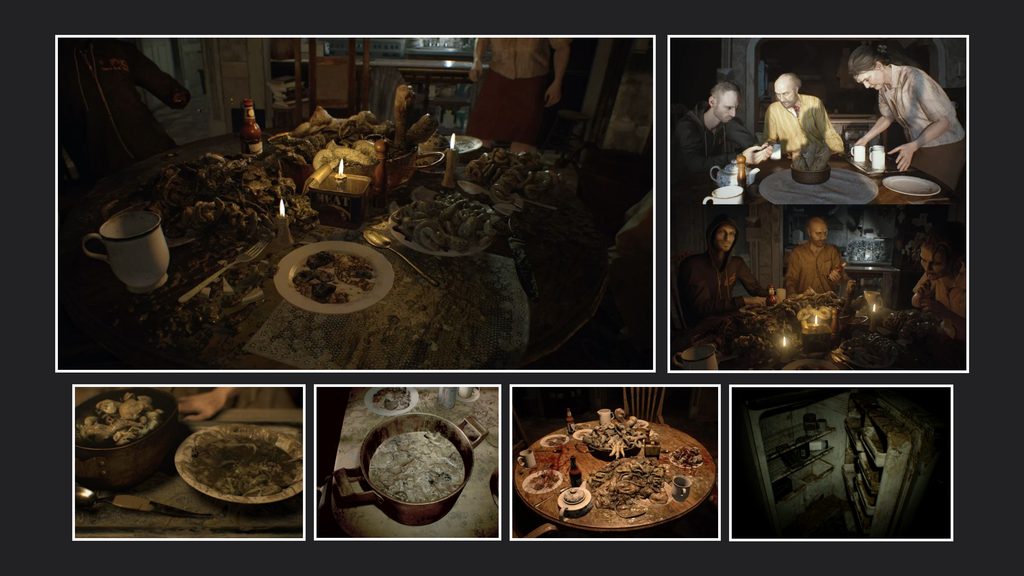
Screenshot from Resident Evil 7 biohazard. © CAPCOM CO., LTD. All rights reserved.
I’d also like to mention that, to me, this scene is a very good homage to Tobe Hooper’s The Texas Chain Saw Massacre. You can feel that influence throughout the game. And the whole environment is filled with small, medium and large props that together form the visual and narrative picture.
I haven’t had a chance to play Gears of War: E-Day yet, unfortunately, but the footage I’ve seen looks very impressive, particularly the level of detail in the props on screen. So, depending on your setting, you’re going to need a lot of chairs, cabinets, bottles, gadgets, plates and assorted junk.
Approaches to creating props
Now I’d like to explain why these categories matter in game production. It comes down to the player’s attention. Quest objects tend to get more of it because players can interact with them directly, hold them in their hands or turn them around in the inventory. They matter to the game design and gameplay, so players are likely to look at them much more closely.
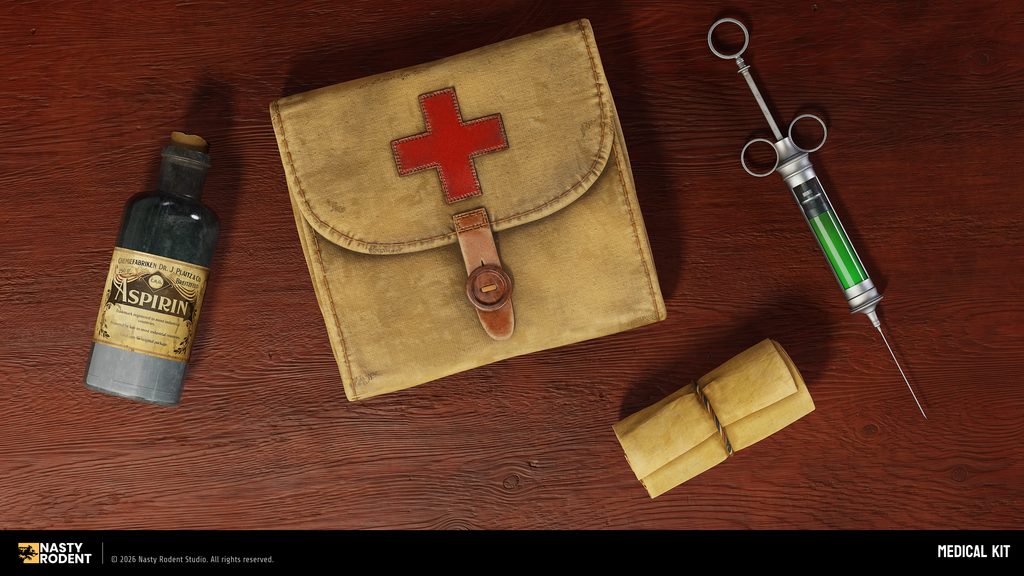
Production teams can take different approaches to these objects depending on the genre, camera angle and scale of the world. One familiar approach is to give an object its own texture set, rather than use a shared atlas that covers a large number of assets. We’ll come back to that shortly. For quest props and objects that tell a story, like the mug or book mentioned earlier, it can make sense for the team to set aside resources for a dedicated texture set that does justice to the game designer’s and art director’s vision.
You could point out that shaders and masks already offer plenty of ways to achieve high quality and give an asset its own identity. And that’s true. We’ve done similar work in Unreal Engine on projects such as La Quimera and Starship Troopers: Extermination. It lets you reuse the same textures and materials, and can be a very good way to optimize a project.
But many quest props still need unique textures because of their design and specific requirements. Developers are often willing to spend a little more here, and the art team can usually buy the tech team a good beer and negotiate a bit of extra memory budget to show the object at its best. You can also combine approaches: give certain parts unique textures and use existing atlases, trim sheets or mask-blended tiling materials for the rest.

With set dressing, the situation can vary quite a bit. Again, it depends on the genre and the size of your world. But this is usually where the artists have to put in the work to make more with fewer resources and fewer textures.
Take a furniture set. You could give every cabinet, chair, table and shelf its own texture set, but you need to understand what that means: a hell of a lot of texture maps. And if it’s a first-person game and you need high texel density, those textures are going to be fairly large. I don’t think buying the tech team a beer is going to solve that one.
So the question is always whether those objects need their own texture sets. Yes, props should be well made. But does every single one need to be special? Probably not, though I’m sure someone will want to argue that point. Set dressing works as part of the overall scene, and most players won’t pay attention to each object individually.
Working with different teams, we’ve seen different approaches and different levels of attention given to props. Whether a particular choice is right or wrong is for each developer to decide, based on both their financial and technical budgets. Coming back to our furniture, there are a few routes you can take besides unique textures.
The first, as we mentioned earlier, is a shader with separate tiling materials: wood, metal, plastic. The basic materials that make up our hypothetical table. You then add a mask whose RGBA channels can each control a different type of detail. For example, R for scratches, G for dust and dirt, B for oxidation, and A for damp patches or water streaks. That’s just one possible way to assign the channels.
Combining all of this in one material can give you a good-looking object. More importantly, you can use the same approach for the entire furniture set. If your table needs distinctive ornaments, handles or other elements that are difficult to achieve this way, you can add a trim sheet or atlas that includes them. It all depends on the object’s design.
The second option is a texture atlas containing those handles, legs, surfaces and other elements for several objects. Or you can build the set around a trim sheet with strips of the materials you need, tiling horizontally or vertically. Reusing one atlas or trim sheet lets you create a whole range of objects instead of just one unique asset.



You’ll constantly be balancing optimization, quality, uniqueness and production speed. Because making every object unique also takes your team’s time, and that time costs money.
A few words on geometry
We’ve deliberately kept the discussion of geometry and its optimization brief in this article, focusing more on textures and materials. On modern PCs and consoles, there’s much more room for detailed geometry now, thanks in part to technologies such as Nanite. In those workflows, polygon counts are no longer as strict a constraint as they used to be. But the available budget still depends on the engine, the target hardware and how many objects you’re showing at once.
Everything we’ve said about the attention given to different types of props also applies to geometric detail. If the player can pick up an object or inspect it up close, its shape and silhouette need the appropriate care. A bottle on a distant shelf may simply not need that level of fine detail. On mobile, polygon counts and levels of detail, or LODs, generally need even closer attention because of the hardware limitations.
So geometry optimization still matters. But when we’re talking specifically about memory, textures are often the biggest memory hogs among art assets, especially if every object has its own set of high-resolution maps. That’s why we’ve spent so much time discussing reuse in this article. Of course, profiling your particular project will show you the actual breakdown.
Conclusion
Your approach to props depends on their role in your game and how much attention the player will give them. Sometimes it makes sense to spend more time on a unique object they’ll remember or examine closely. Elsewhere, one well-planned set of materials can let you furnish an entire room that looks convincing and supports the atmosphere.
I think these are the things worth discussing before the team starts making dozens of chairs, cabinets and bottles. What will the camera be like? What can the player pick up? Which objects tell a story, and which ones need to support the overall scene? That gives the artists a clearer sense of where to spend their time, and makes it easier for the tech team to work with the assets once they go into the engine.
And while players probably won’t remember every little plate in the Bakers’ house, they will remember how the place felt. All those small, medium and large props we’ve talked about today contribute to that.
Let’s work on your project
If you need help creating props for your game, the team at Nasty Rodent would be happy to join your project. We can work within your established pipeline and technical requirements, or help you choose an approach if you’re still weighing your options.
Together, we can work out which objects need unique textures and more detail, and where shared materials, atlases or trim sheets make sense. Tell us about your game and what you need, and we can discuss how to organize the work around your artistic vision, technical constraints and budget.
Let's work
together


in mind?
From 3D characters and environments to weapons, props, concept art and game UI/UX: ten years deep, 40+ artists strong, zero fluff. Tell us what you are making and get a free, no-pressure estimate.
estimate